![Hey Decor Girl [Latest Trending Decor Design Ideas]](https://heydecorgirl.com/wordpress/wp-content/uploads/2024/08/Heygirldecor-Logo.png)
Apartment Balcony Ideas With Privacy can be a mini-oasis in the urban lifestyle, surrounded by its chaos and noise. Yet, they may feel vulnerable unless they are provided with suitable privacy. Privatizing your balcony can make it a relaxing environment where you can spend some time, relax, entertain, or just have a moment of privacy.
The use of a balcony will be fully realized by creating a personal and cozy outdoor environment within an apartment. It also helps you forget about the watch of the neighbors and passers by, creating a place that feels like your own. Privacy options can also add to a more casual and intimate setting, and make your balcony a more useful and attractive part of your place.
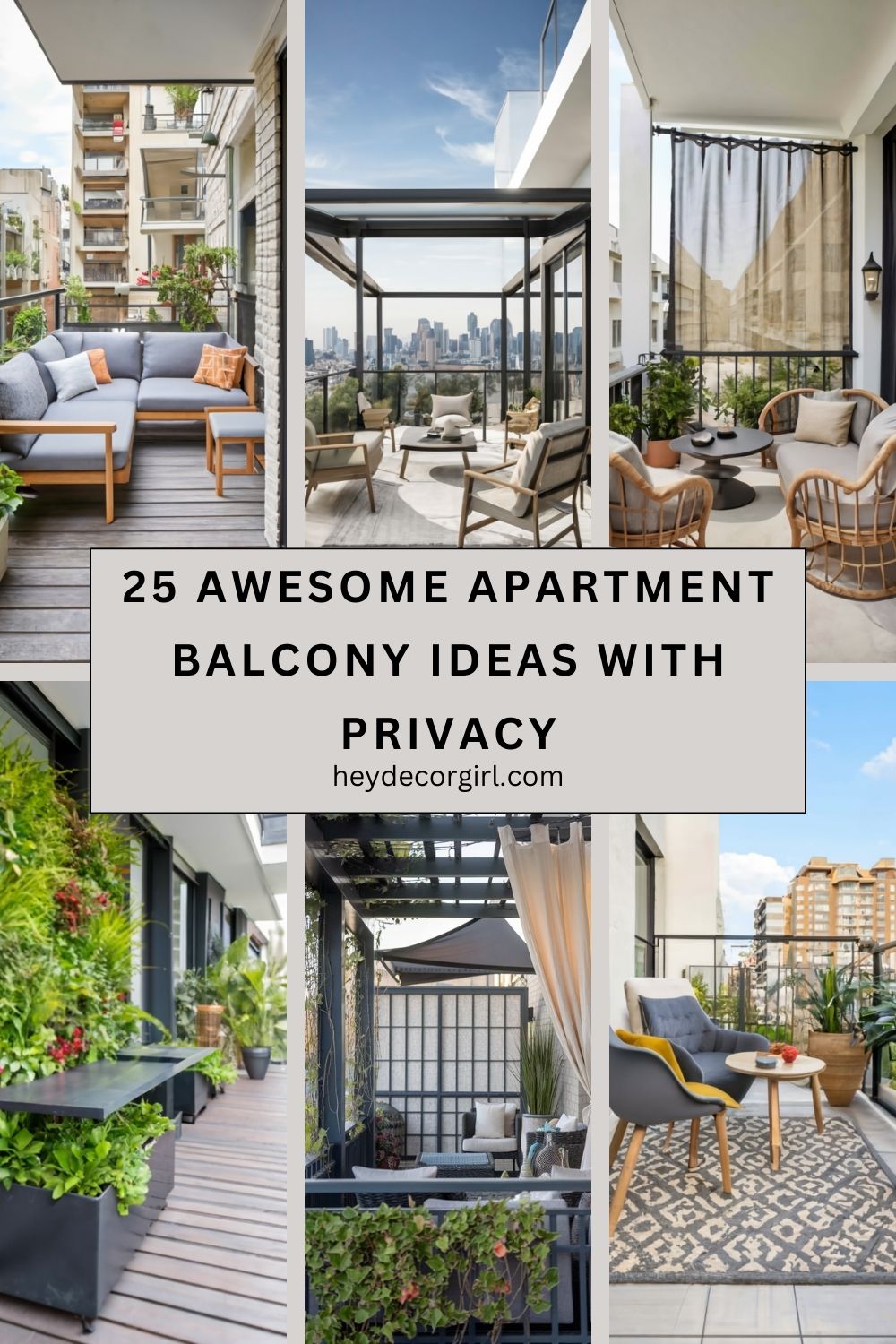
Privacy features in your balcony would not only enhance your comfort but also enhance the aesthetic value of your balcony. Natural barriers, such as plants to ornamented screens or structures, serve to describe your space and improve your overall living experience. We’ll discuss 25 great apartment balcony ideas with privacy in the sections that follow to give you the inspiration to take on your next outdoor project.
Awesome Apartment Balcony Ideas With Privacy
1. Privacy Screens and Dividers
The various types are described below:
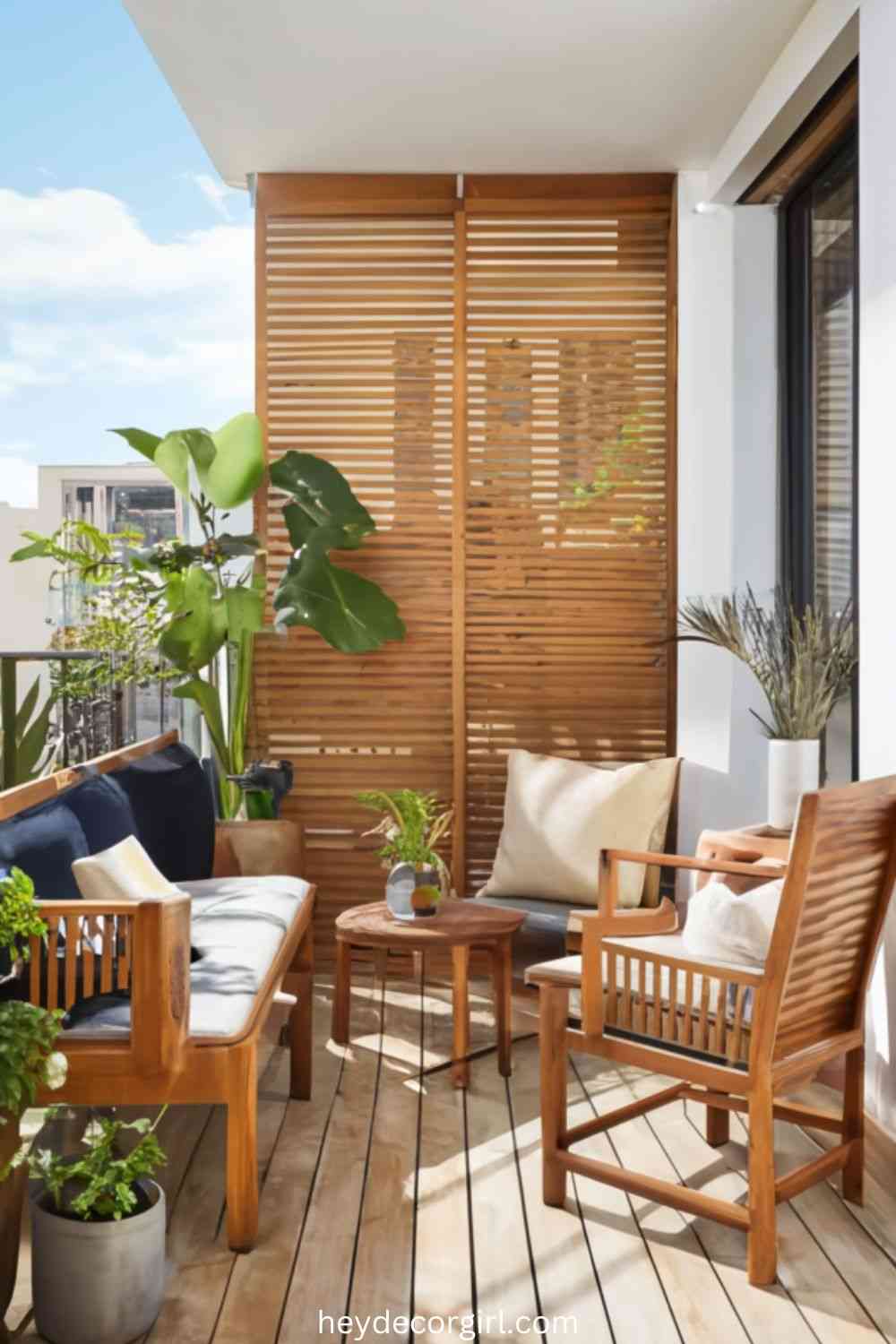
- Wooden Screens: A Wooden privacy screen comes with a natural appearance, which can be used to add beauty to your balcony. They are available in a range of designs, such as solid panel, slatted, or trellised.
- Bamboo Screens: Bamboo screens give a tropical and exotic ambiance, and are a wonderful option to instill a green border. They are easily installed and usually lightweight.
- Lattice Screens: Lattice screens are generally composed of wood or plastic and have a crisscross design. They are multi-purpose and can be used both to support climbing plants and provide privacy.
Pros and Cons of Each Type:
Wooden Screens:
- Advantages: sturdy, customizable, and comes in different styles and finishes. They are also paintable or can be stained to suit your balcony.
- Negatives: Heavy and may require service to prevent weathering and rot. Installing larger screens may need professional assistance.
Bamboo Screens:
- Advantages: It is lightweight, cheap, and looks naturally eco-friendly. Easy to install and maintain.
- Disadvantages: Not as durable as wood and will be susceptible to breaking or bending when subjected to extreme weather conditions. May should be replaced after a certain period.
Lattice Screens:
- Advantages: Versatile and may serve other purposes, such as privacy and supporting plants. Very light and simple to fit.
- Disadvantages: It may not be totally confidential because there are holes in the lattice. Not as resistant as solid screens, and sometimes need further support.
Installing tips: To Install Themm:
- Install Properly: Well before buying or setting up a screen or divider, measure the space in which the screen or divider will be installed.
- Select the Suitable Material: Take into account weather forecasts and the amount of privacy required. To the point of example, in a windy location, you should consider using more durable materials, such as wooden or strengthened bamboo screens.
- Fasten Safely: In wooden and lattice screens, be sure that they are firmly attached to the wall to prevent their overthrow. Install proper mounting hardware or brackets, and may also use wall anchors when mounting to a wall.
- Care: Clean up a wooden and bamboo screen and spot any damage or wear. Weatherproof wood and clean bamboo screens to prevent mildew and mould and increase life.
- Plant It Up: In the case of lattice screens, it is advisable to add climbing vegetation to increase privacy and beauty. Select varieties that grow rapidly to soon cover the lattice and offer more privacy.
With the appropriate kind of privacy screen nd proper installation, you can also enjoy your apartment balcony and make it a little more intimate.
2. Outdoor Curtains
Various Curtain Materials:
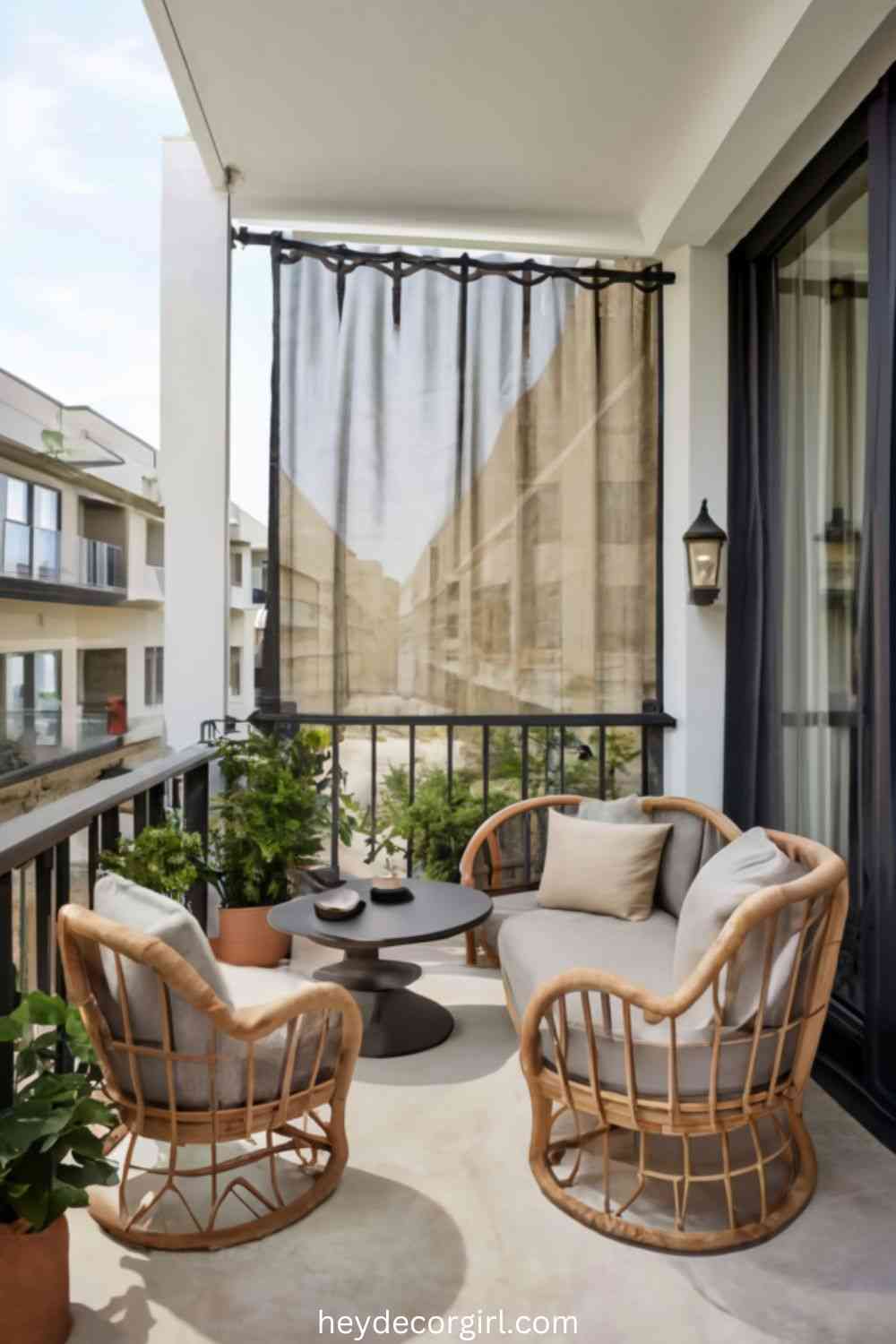
Outdoor Fabric Curtains: featuring strong materials like polyester or acrylic, outdoor fabric curtains are meant to resist the sun and light rain. They are available in a range of weights and can offer a good level of privacy, although some light may penetrate through them.
Waterproof Curtains: Waterproof curtains are usually composed of vinyl or treated polyester and used where a lot of rain or moisture is present. They are fully waterproof and simple to wash, but might not be as breathable as other substances.
Sunblock Curtains: These are special curtains that are created to block UV rays and make the balcony less hot, as well as keep furniture in the house out of the sun and prevent fading. They usually have a special coat that provides an added level of privacy.
How to Hang and Fasten Outdoor Curtains to Get the utmost privacy:
Choose the Right Hardware:
- Install rust-resistant curtain tracks or rods that are meant to be used outdoors. When it comes to heavy curtains, make sure the hardware is robust and able to sustain the weight.
- It might be nice to use a curved or angled rod on the curtain to create a semi-closed space.
Install Properly:
- Mounting: The curtain rod or track should be securely attached to a solid surface, like a wall or ceiling. Make sure the mounts are flat and well-anchored to support the weight of the curtains.
- Height: The curtain rod should be placed high enough so that the curtains can touch the floor or nearly touch the floor, which will increase the privacy and coverage.
Adjust for Fit:
- Curtain Length: The coverings should be long enough to cover the whole space and avoid any holes that will expose the privacy.
- Curtain Width: Curtains that are wide enough to cover the area completely, even as they are drawn upon. Sometimes the curtains may have to overlap,p, or you can cover them with many panels.
Secure the Curtains:
- Tiebacks or Weights: Place tiebacks or weights at the base of the curtains to avoid them being blown into the wind. This will preserve privacy, and the curtains will remain in place.
- Curtain Clips orHooksk: To make the curtains more secure, use clips or hooks to fix the curtains to the rod or track. This helps to ensure that the curtains are not easily moved by wind or movement.
Maintain and Clean:
- Wash the outdoor curtains frequently to eliminate dirt and mildew. Wash and dry according to the care instructions provided by the manufacturer.
- Periodically check the hardware attaching to the hardware and balances and counterchecks of the curtains to make sure they are attached.
Outdoor curtains can deliver a cool and practical solution to the problem of gaining more privacy on your balcony by using the right materials and adhering to these installation tips.
3. Vertical Gardens
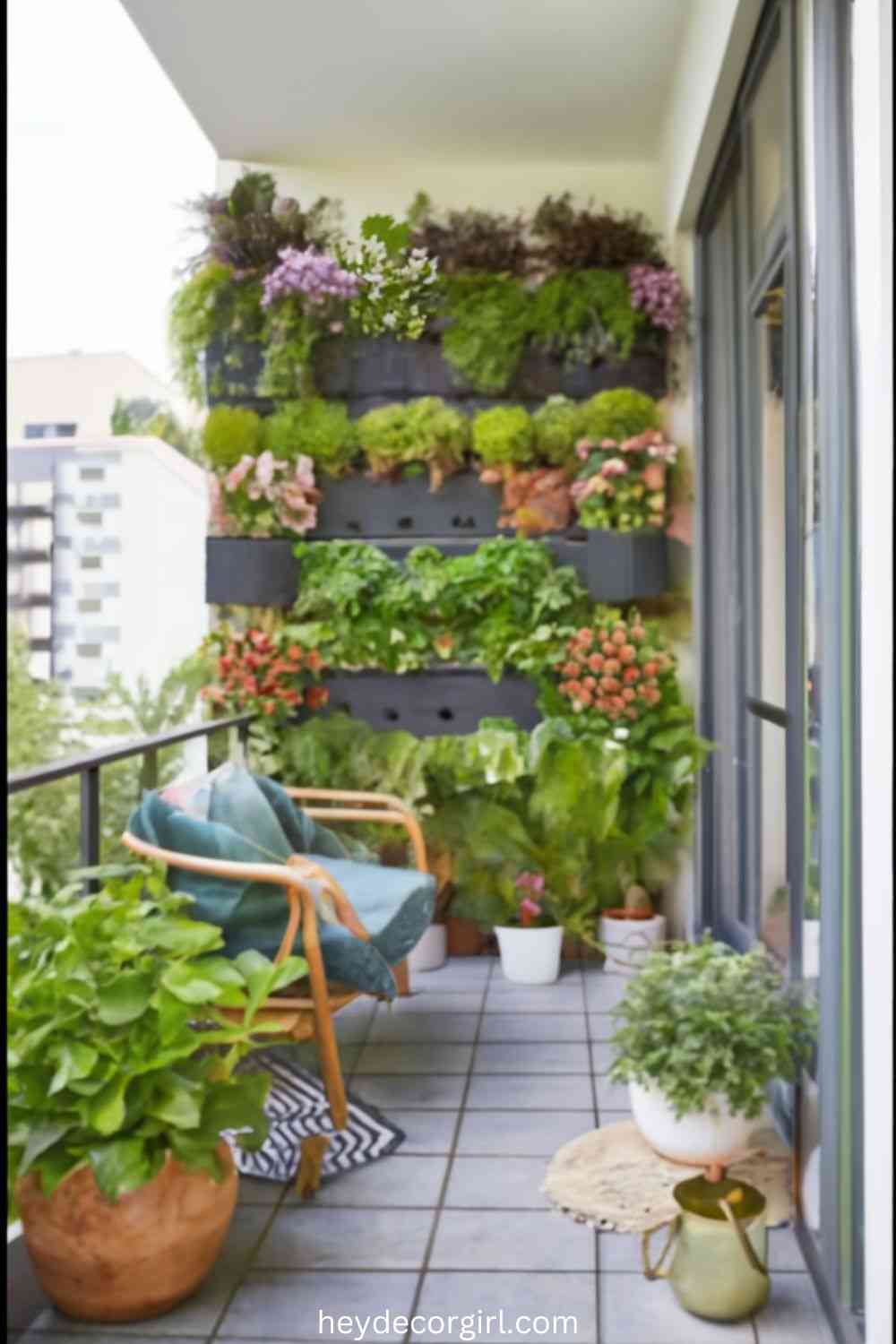
How Vertical Gardens Can Be Privatizing Screens:
Vertical gardens are the new way to optimize space and increase privacy on the apartment balcony. Planting horizontally on vertical surfaces will allow you to build a green and fertile wall that will serve aesthetic purposes in addition to providing a natural privacy barrier. This is simply a way of providing an outdoor space that can be utilized without compromising essential floor space. Mount vertical gardens can be attached to walls, fences, or custom-made frames, which provides a viable way to build a personal retreat in a city or small spaces.
Planting Ideas: fast-growing plants to provide cover:
Climbing Vines:
- English Ivy: This is a hardy and fast-growing plant that can easily cover a vertical surface. It is a thick, green wall and very good at privacy.
- Clematis: This is a flowering vine, and it grows very fast and can be trained to cover trellises or even vertical frames to provide both the greenery and flowers.
Fast-Growing Annuals:
- Sweet Peas: Sweet peas are fast-growing flowers with a strong smell, and can be trained around vertical features using their hanging vines.
- Morning Glories: This is a rapidly growing plant with large, colorful flowers, and it may be able to cover a vertical surface very fast. They also offer thick foliage for privacy.
Trellis Plants:
- Hops: Hops are very common in brewing, and they are prolific climbers that, once planted, can cover a trellis or a vertical garden system that forms an opaque screen of green.
- Passionflower: This is a fast-growing, exotic vine that grows in large flowers and is a good choice to cover up vertical structures.
Perennial Climbing Plants:
- Boston Fern. This type of fern has a dense, feathery foliage that is capable of covering vertical space. It grows in the shade or semi-shade.
- Wisteria: The wisteria is a high-growing perennial, and with its hanging bunches of flowers, offers tremendous cover to the vertical gardens.
Green Wall Systems:
- Modular Green Walls: This type of wall will be made up of pockets or pre-plantable panels that can be attached to a wall. They can be fitted with different plants that can grow quickly to form an instant privacy screen.
Vertical garden: How to set up a vertical garden to achieve privacy:
- Select the Correct Structure: Select trellises, wall-mounted planters, and custom-designed frames that are sufficiently strong to hold the weight of fully grown plants.
- Choose Right Plants: Choose plants that suit your local situation and lighting. Make sure that they are fast-growing and can cover densely.
- Frequent Watering: Maintain the garden by ensuring it is well watered and fertilized. Prune frequently to keep in shape and to avoid overgrowth.
- Irrigation Plan: Install an effective watering system, like drip irrigation, to keep your vertical garden watered.
With vertical gardens on your balcony, you can have a beautiful and intimate garden that improves the aesthetics of your exterior as well as the practical value of the space.
Also Read: 15 Amazing Wall Decoration For Balcony Ideas
4. Planters and Green Walls
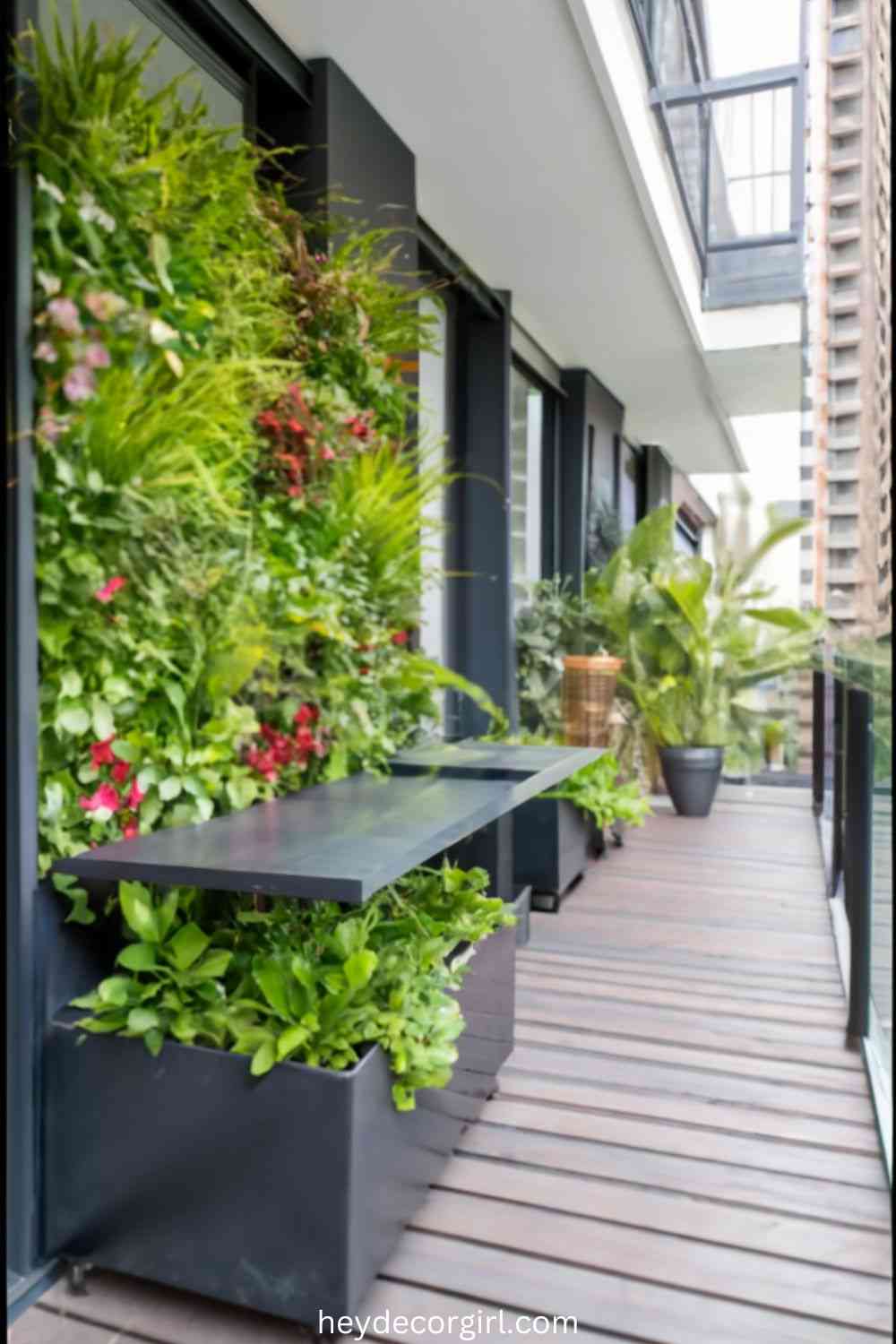
Planning with Planters to Build Natural Barriers:
Planters provide a universal solution for making natural barriers in your balcony. They can be designed in strategic locations to create visual and physical barriers and provide privacy and foliage. Planters are used like this:
Choose the Right Planters:
- Use large, heavy planters, which can sustain the growth of tall plants or shrubs. Ceramic, fiberglass, or metal are good examples of materials that can be used outside.
- Plant in planters that have inbuilt irrigation systems so that plants get water regularly and are healthy.
Planting: Place with Care:
- Border the Edges: Line your balcony with planters to provide a border and more privacy. Select plants or shrubs that are taller to grow upwards and create a natural wall.
- Divide your Balcony: Plant your balcony by dividing various spaces with planters to create a dining and a lounging area. Lay them in a row or staggered to give them more visual interest.
- Layering: Adding layers: Add a mix of planters to achieve a mix of heights and sizes. Plants that are not that tall and have decorative foliage are shorter, hence providing texture and depth to the view, whilst taller planters that contain bigger foliage may obstruct the view.
Select Plants for Privacy:
- Tall Grasses: Tall grasses, such as ornamental grasses, may be tall and thickly grown to offer a dense sort of screen. They are blown by the wind that gives a natural and flowing feeling to your privacy shield.
- Evergreens: Evergreens are dwarf conifers or boxwood that cover the garden all year round and continue to have foliage all through.
- Hedging Plants: Plant hedges such as lavender or rosemary, which may grow to form thick hedges providing privacy and pleasing fragrances.
Guide to Making a Green Wall featuring Climbing Plants:
Greenwall is a very good solution to make use of as much of the available vertical area as possible and to provide a privacy screen in green. Here’s how to create one:
Choose the Right Structure:
- Wall-Mounted Planters: Pocket/Install wall-mounted planters or pockets where climbing plants may be placed. These may be off-the-shelf or bespoke systems.
- Trellises or Frames: Use trellises or vertical frames on the wall of your balcony. These structures do assist climbing plants and permit them to cover the wall.
Select Climbing Plants:
- Quick-growing Vines: Select climbing vines such as English Ivy, Wisteria, or Jasmine that grow rapidly and cover the wall successfully. Such plants also provide seasonal color and scent.
- Perennials: Use an annual climber such as Clematis or Passionflower as a green wall that will come back every year and bring lovely flowers.
Install and Train Plants:
- Planting: Put the climbing plants in the planters/pots mounted on the wall. When a trellis is used, the vines should be raised at the base of the structure and then led onto it softly.
- Training: Growing the plants, take plant ties or clips to direct the growth. Trim and prune regularly to promote full cover and to avoid tangles in the plants.
Maintain the Green Wall:
- Watering: Watering should be done regularly, because the watering of vertical gardens might dry out much more quickly than in a normal garden bed. You may want to install a rip irrigation system.
- Feeding: Feed frequently to favor healthy development and colorful foliage.
- Pruning: Trim and maintain the plants regularly to ensure that the green wall looks trim and to stimulate new growth.
You can make your balcony a private and green oasis, increasing privacy and beauty by placing planters to build natural barriers and designing a green wall comprising climbing plants.
5. Trellises with Climbing Plants
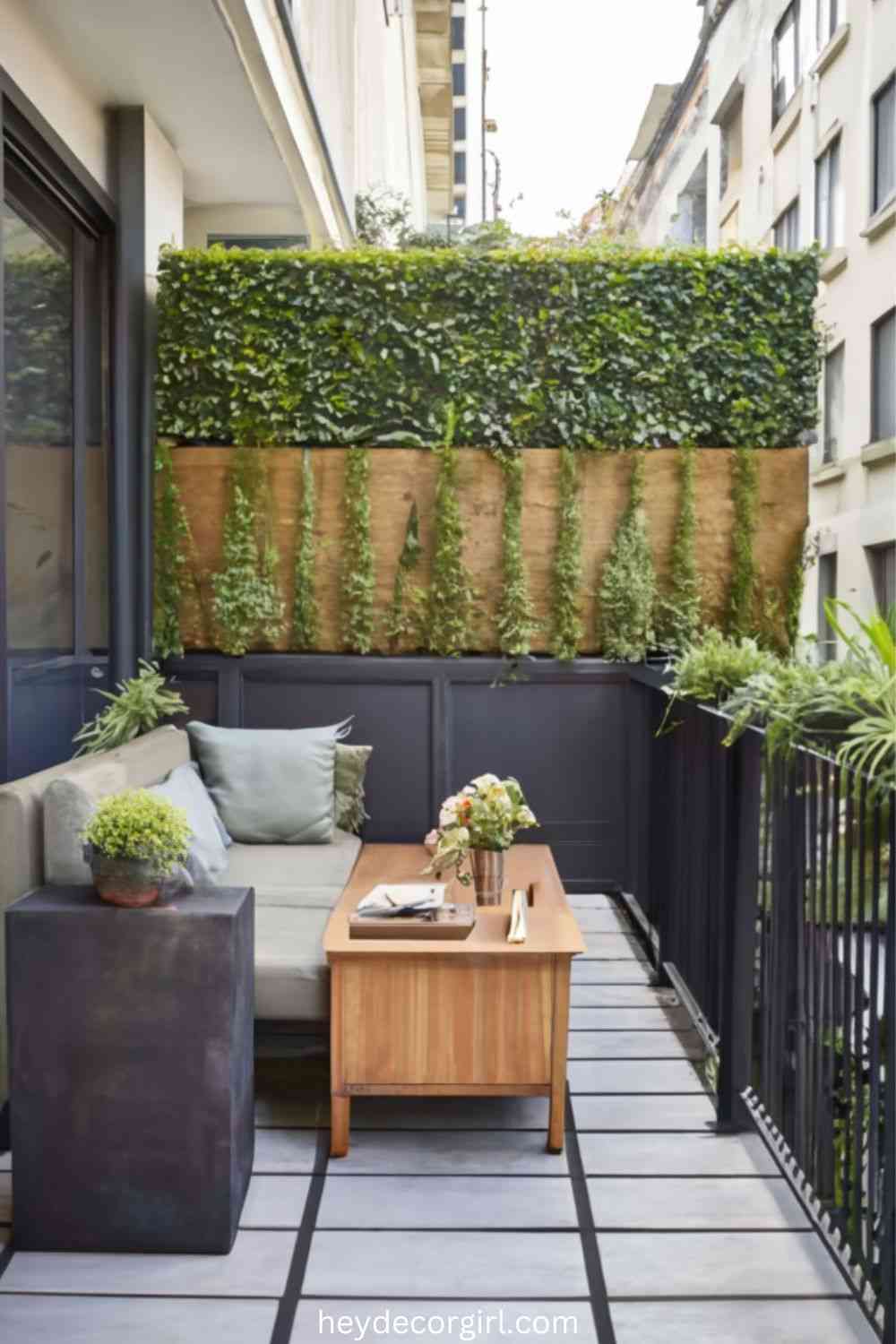
Most Suitable Trellises on Balconies:
Wall-Mounted Trellises:
- Description: Trellises attached to the wall of the balcony. They are well-suited to small areas and could be mounted vertically to maximize privacy.
- Materials: Metal, wood, or plastic. Metal trellises are strong and up to date, whereas wooden trellises have a natural, traditional appearance. Plastic solutions are light, weatherproof.
Freestanding Trellises:
- Description: Trellises are detached from the floor of the balcony. They can be put against walls, or they can be used to make divisions in the space.
- Material: Wood or metal. Wood is a more rustic option, with metal trellises being smoother and modern. Make them strong and fixed firmly on the ground so that they do not tip.
Arched Trellises:
- Definition: Trellises where the actual framework is curved or arched to form an ornamental entryway or focus point of the balcony. They can add a sense of elegance and help climbing plants.
- Materials: Metal or wood. Arches made of metal may be more decorative, whilst wooden arches have a more traditional look.
Expandable or Folding Trellises:
- Description: Extensible and foldable trellises provide flexibility in their design. They are perfect to adjust the design or to scale up the trellis to the area.
- Material: Metal or bamboo. Expandable metal trellises are tough and adjustable, and bamboo offers a natural, lightweight alternative.
Plants recommended to create a private area to climb:
English Ivy:
- Descriptio:n This is a strong climber with thick foliage that is fast at covering trellises to form a green screen. It is perfect to cover and give privacy.
- Care: Likes shade to half-day sun. Clip regularly to curtail growth and reduce overtake.
Clematis:
- Description: It is a climbing plant that grows beautiful flowers of all colors. It is fast-growing and can be used to cover trellises, providing privacy as well as beauty.
- Caution: Needs full sun to partial shade. Clip and wire after the bloom to keep it in shape and to get new flowers.
Wisteria:
- Descriptio:n Wisteria is a fast-growing vine that forms a wonderful thick canopy on trellises with its cascading groups of sweet-smelling flowers.
- Care: Thrives in full sun. It should be pruned regularly so that it is kept under control and does not grow too heavy.
Passionflower:
- Description: Special flowering, exotic vine, fast growing, with unique, colorful flowers. It is a good trellis cover and is also a colorful and interesting privacy screen.
- Care: Likes complete sun to partial shade. Trim to control the growth of the prune and keep it covered.
Hops: - Description: This is a strong, quick-to-grow vine that is used in brewing, and it covers trellises rapidly. It makes a thick, green wall and gives it a natural textured appearance.
- Care: Needs complete sun and water. Prune to check growth and to provide uniform cover.
Jasmine:
- Description: A fragrant climbing plant with dainty yellow or white flowers. It develops fast and can cover a rellis with its green leaves and flowers.
- Care: Likes complete sun to partial shade. It grows vigorously, and regular pruning can keep it in shape.
Climbing Plants: Some Advice on Planting Trellises:
- Choose the Right Trellis: Decide on a trellis that fits the size of the balcony and the growth size anticipated for the plants.
- Attach the Trellis: Mount the trellis so that it is firmly attached or hooked down so that it does not topple over when the plants grow.
- Training the Plants: Climbing plants can be trained onto the trellis with a plant tie or clip in order to promote even distribution.
- Care: Water and fertilize the climbing plants when necessary, and often prune to keep the shape and good health of the plants.
With the right kind of trellis and climbing plants, you can make your balcony into a beautiful and private outdoor space.
6. Balcony Enclosures
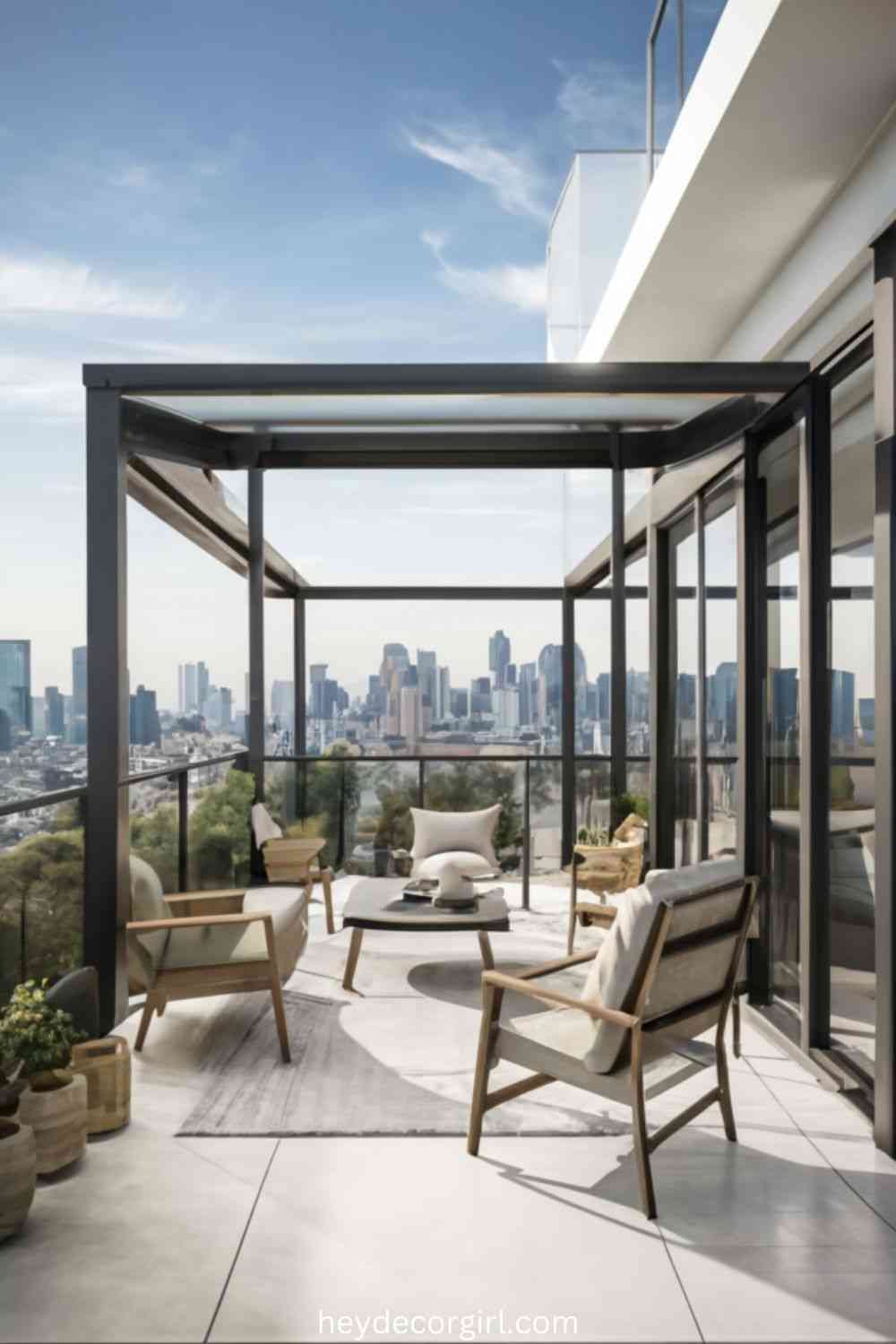
Advantages and Disadvantages of Glass, Acrylic, or Mesh Enclosures:
Glass Enclosures:
Pros:
- Clear View: It gives a clear view of the outside without a lot of privacy. Perfect for viewing the urban or natural environment.
- Weather Protection: Covers wind, rain, and dust, allowing the balcony to be used in different weather conditions.
- Aesthetic Appeal: Gives the balcony a modern, smooth appearance and can increase the value of your property.
Cons:
- Expense: In general, it is more expensive than acrylic or mesh enclosures. The installation process can be complicated and needs the assistance of a professional.
- Washing: It should be washed frequently to keep it clean, and may have a propensity to be smudged or streaked.
- Temperature Control: Ability to trap he, which might result in making the space warmer during summer.
Acrylic Enclosures:
Pros:
- Durability: Acrylic is shatter-resistant and more impact-resistant than glass. It is a more elastic substance that may be simpler to install.
- Lightweight: It is less expensive and easier to install as it is lighter than glass.
- UV Protection: UV protection is sometimes applied to prevent the fading of interior furnishings and provide some insulation.
Cons:
- Scratching: Scratching is much simpler on acrylic than on glass, which might need cleaning and maintenance regularly.
- Distortion: Sometimes a slight distortion or tint may be present, which may influence the view.
- Cost Change: Although the quality of acrylic is usually cheaper than glass, high-quality acrylic is also expensive.
Mesh Enclosures:
Pros:
- Cost-Effective: This is the least expensive option, generally. It can be installed more easily and cheaply.
- Ventilation: This offers some privacy and protection against insects, yet at the same time allows air flow.
- Flexible Design: It is easily adaptable or removable and can thus be used in various applications.
Cons:
- Less Privacy: Less privacy than glass or acrylic: Can be transparent with the density of the mesh.
- Weather Protection: Is less resistant to severe weather conditions, such as precipitation or severe winds.
- Maintenance: Mesh can be covered with dust and debris and requires cleaning very often.
Installation Tips:
- Measure Accurately: Make sure the measurements of the area in the balcony are accurate so that the enclosure fits. Take measurements of height, width, and any irregularities within the space.
- Choose Quality Materials: Use the best quality of materials according to your needs and climate. Take durability, weatherproofness, ss, and beauty into account.
- Professional Installation: In case of glass or complicated acrylic enclosures, it is recommended that one hire a professional who can guarantee the correct installation process and also adhere to the safety measures. It is important to seal and align properly.
- DIY Installation: Mesh or other less complicated acrylic will have to be used; instructions should be followed. Fasten the enclosure with the right tools and anchors.
- Check Regulations: Check with local building regulations and codes concerning balcony enclosures. Certain locations might impose certain measures or demands.
Maintenance:
Cleaning:
- Glass: clean with a soft cloth and glass cleaner. Clean up to keep it clear and attractive.
- Acrylic: Wipe with a soft cloth using a mild detergent to avoid scratches. Gargle away coarse cleaners and materials.
- Mesh: Clean up litter routinely by brushing and rinsing in mild soap and water. Wash completely and dry.
Inspection:
- Always inspect to identify any damage or wear, particularly of acrylic and mesh enclosures. Check cracks and loose fittings, or deterioration.
Repairs:
- Solve any problem immediately to avoid additional destruction. In the case of glass and acrylic, major problems can require professional repairs. Mesh may be patched or replaced.
You can easily maximize the use of your balconies and maximize their privacy by knowing the advantages and disadvantages of each form of enclosure and by observing appropriate installation and maintenance guidelines.
Also Read: 15 Best Balcony Holiday Decorating Ideas
7. Outdoor Rugs and Mats
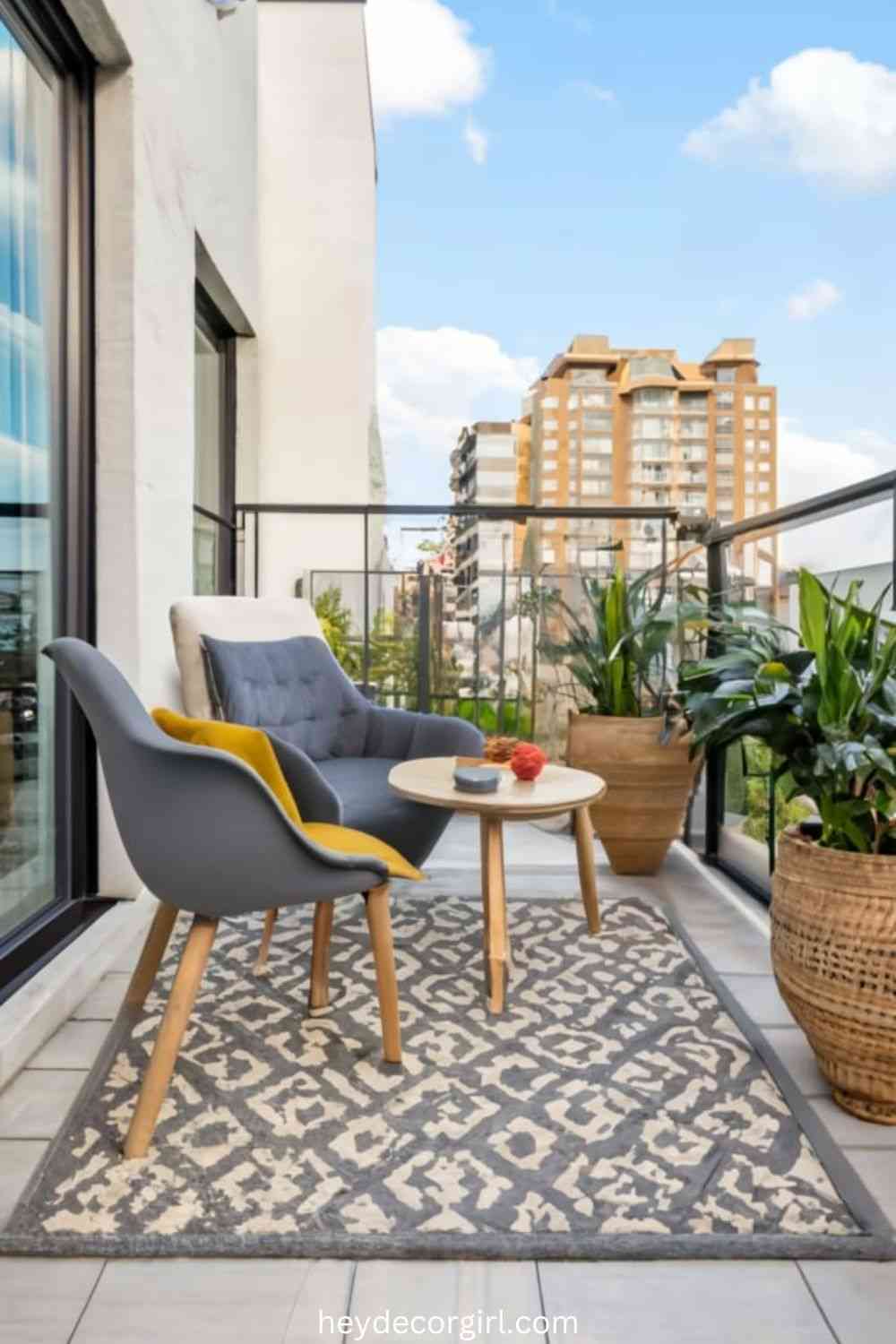
Selecting Rugs That Provide Style and Privacy:
Material Options:
- Durable Fabrics: Select outdoor flooring that is composed of weatherproof fabrics such as polypropylene, polyester, or nylon. The materials are resistant to moisture, UV radiation, and foot traffic without requiring any maintenance.
- Natural Fibers: Natural fibers, like sisal, jute, or bamboo, will give your rug a more textural and earthly appearance. They are also not as water-resistant, but they can be treated to be durable and used under a cover or somewhere semi-covered.
Design and Patterns:
- Privacy and Aesthetics: Choose a pattern or colour of rugs that matches your decoration in the balcony and helps to create a privacy effect. The plucky patterns or the dark colors can physically block portions of the balcony and make the area look even warmer.
- Layering: Think about layering smaller rugs atop a larger base rug that can give the different spaces their own identity and add depth to the design. This technique may also produce a more personalized distance effect.
Size and Shape:
- Proportional Sizing: Choose rugs to fit the size of your balcony. Huge rugs can establish the space and provide a clear area, whereas smaller rugs may mark certain areas, including eating or resting.
- Shape Alternatives: Unlike other options, shapes may be structured to accommodate your floor plan, or even to be custom-designed to create a unique shape that suits your balcony pattern.
Arrange Objects to Mark Your Delimited Spaces in Your Balcony:
Seating Area:
- Placement: Add a giant outdoor carpet to your sitting setup to create a lounging space. The carpet must be larger than the furniture to give out a seamless and homely ambience.
- Layering: Add another layer on the floor with a smaller rug or mat at the front of the sitting space to provide more texture and further define this area. This also contributes to isolating it from other parts of the balcony.
Dining Area:
- Placement: Under the dining table and chairs, put a rug and have a specific dining area. Make sure that the rug is big enough to fit the table and the chairs, even when they are pulled away.
- Shape: Round carpets can be used when the table is circular,r ane rectangular or square carpets when the table is rectangular or square.
Entrance and Pathways:
- Placement: Outdoor mats or runners at the door of your balcony will welcome your visitors and help to keep dirt and moisture away. Runners may also be specified to traverse the various areas of the balcony.
- Functionality: Select mats with a textured or patterned surface or pattern that will trap dirt and moisture, making the mats both practical and attractive.
Privacy Zones:
- Placement: Divide the space with rugs in various parts of the balcony, e.g., a reading corner or a small garden. The rugs will physically divide the space and provide an element of privacy.
- Color Coordination: Coordinate colors with contrast or complement to visually differentiate areas and increase the feeling of privacy.
Balcony Corners:
- Placement: Have some rugs in the corners of your balcony with which to make it cozy and inviting. This can be useful, especially with smaller balconies where there is little space and where privacy is a concern.
- Design: Rugs should have patterns or textures to help attract attention to these corners and make them seem more private and welcoming.
Tips for Maintenance:
- Frequent Cleaning: Have outdoor carpets vacuumed frequently to get rid of dust and debris. To clean thoroughly, a mild detergent and water should be used, and the rug should be dried thoroughly to avoid mold and mildew.
- Protective Measures: Place rug pads or anti-slip mats to secure the rugs and increase the life of the rug. Also, think about having a rug cover or leaving the rug
- inside when it’s raining heavily or when it is cold.
With proper selection of outdoor rugs and their right placement, you can create a better style and privacy of the balcony and a defined and inviting space to relax and enjoy.
8. Privacy Panels
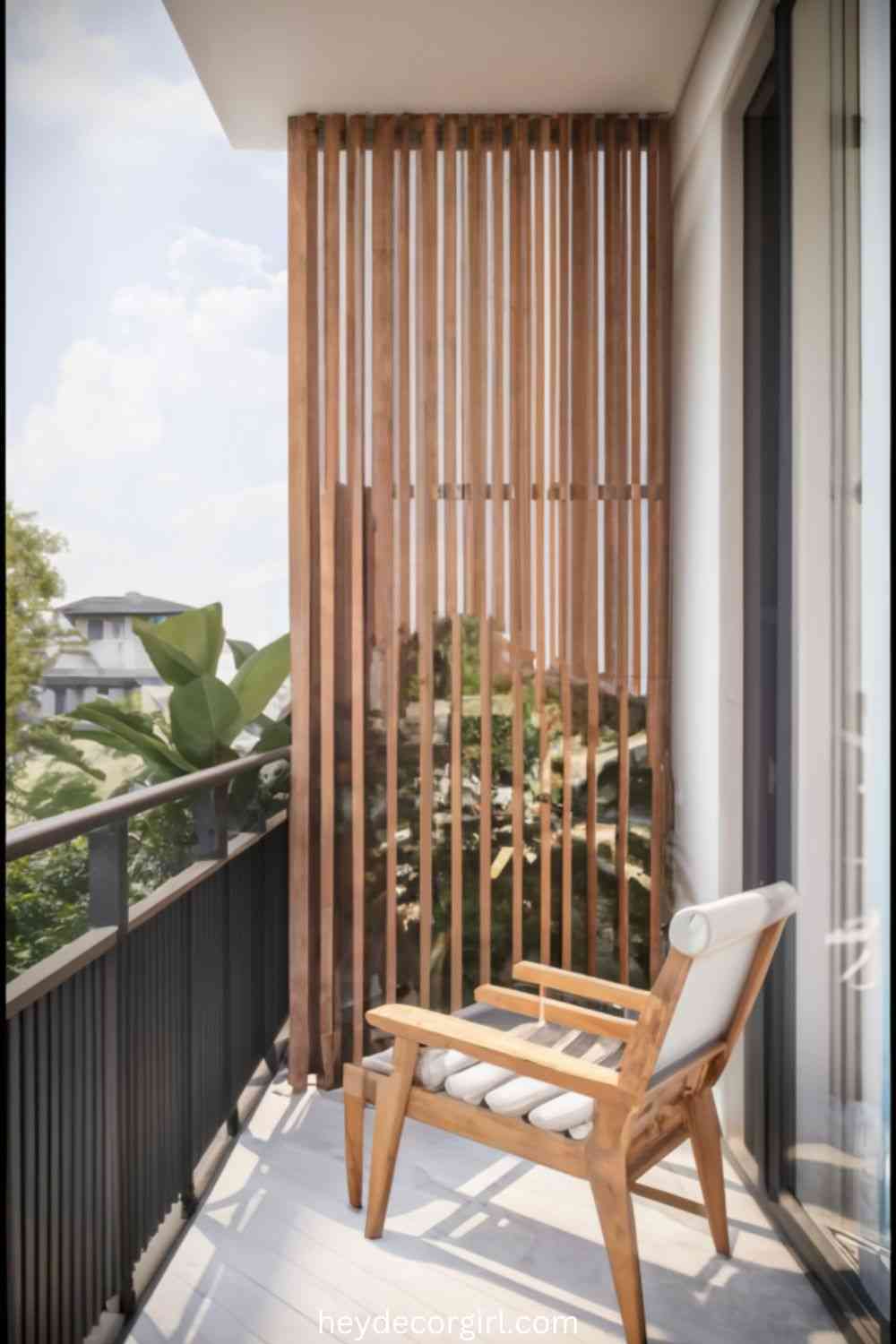
Privacy Panel made of different materials and designs:
Wooden Panels:
- Description: Virtue and universal, wooden privacy panels are natural and warm. They are available in many designs, such as slatted, louvered, or solid panels.
Design Options:
- Slatted Panels: Slats are horizontal or vertical, but with openings that allow some light and air, yet offer privacy.
- Louvered Panels: These are panels that have angled slats that separate light and views in a certain direction without losing privacy.
- Solid Panels: Provide the highest level of privacy, having a solid surface.
- Advantages: Reliable, customizable, and can be painted or stained to suit your aesthetics.
- Cons: It needs frequent maintenance to avoid weathering, and sometimes it needs to be sealed or treated.
Bamboo Panels:
- Description: Bamboo panels are more environmentally friendly and can lend a tropical/ natural appearance to the balcony. They exist in a wide range of forms, including rolled or assembled panels.
Design Options:
- Rolled Bamboo: It is flexible and can be attached to the existing structures or framework.
Ready-Made Panels: Rigid panels are available in standard sizes and finished appearance.
Advantages: It is lightweight, strong, and provides the natural”:
Disadvantages: May decay or wear down through exposure to the elements and need to be replaced or treated periodically.
Metal Panels:
- Appearance: Metal paneling provides a modern, industrial appearance and comes in aluminum, steel, or wrought iron. They may be perforated or solid.
Design Options:
- Perforated Panels: They have ornamental patterns or designs that provide privacy but some light and air.
Solid Panels: Are fully private and have a smooth, modern look.
Advantages: strong, low maintenance, can be sprayed with any color.
Cons: It will cost more and can overheat in direct sunlight.
Fabric Panels:
- Description: Fabric panels are a less permanent alternative to privacy and are more affordable. They are made of different materials such as outdoor fabrics or canvas, or polyester.
Design Options:
- Outdoor Fabric Curtains: These can be mounted on a track/rod, and they can be pulled to the side when they are not in use.
Canvas Panels: They can be attached to frames or structures.
Advantages: Easy to install and uninstall, comes in different colors and patterns.
Cons: Can be easily cleaned and is less durable than other materials.
Glass Panels:
- Description: Glass panels have a modern appearance and are smooth with a sleek look, and provide privacy with frosted (or tinted) panels.
Design Options:
- Frosted Glass: This offers privacy and also lets light through.
Tinted Glass: Provides privacy and can eliminate glare.
Advantages: Cool, low maintenance, and it lets in light without compromising on privacy.
Disadvantages: Can be costly and can only be installed by a professional.
Installing the applications and customization:
Mounting Methods:
- Wall-Mounted: Wall-mounted FASTENER Mount panels onto the walls of the balcony with brackets or screws. It can be used with fixed panels and offers a solid installation.
- Free-Standing Frames: The panels are supported by means of an applied frame or support so that the placement of the walls can be flexible and can be easily removed should the occasion arise.
- Ceiling-Hung: In the case of fabric or lightweight paneling, hang the paneling by rod or track through the ceiling. The technique is best suited to building an elastic, movable wall.
Customization Options:
- Size and Shape: Custom size and shape: The panels are designed to fit your size and style of the balcony. Panels may be cut to fit or adjusted to fit areas or angles.
- Finish and Color: Select finishes and colors that match up with your decorations on the balcony. Wood may be stained/painted, metal may be powder-coated, and cloth may be chosen in different patterns and colors.
- Extra Accessories: Another option would be to include features such as in-built planters, lights, or ornaments to improve the functionality and aesthetics of the privacy screens.
Maintenance Tips:
- Wooden Panels: Clean and treat with sealant or stain regularly to prevent weathering and to have a lean and attractive appearance.
- Bamboo Panels: Damages should be periodically checked, and a protective finish applied to avoid any deterioration.
- Metal Panels: Wipe down with a little soap and water and fill any scratches or holes in the finish.
- Fabric Panels: Laundry or dry clean as necessary, and change when the cloth gets torn or battered.
- Glass Panels: Wipe with glass cleaner and a soft cloth to keep glass clean and free of smudges.
The choice of materials and methods of installation of your privacy panels will allow you to improve the privacy and aesthetics of your balcony, making the outdoor space comfortable and welcoming.
9. Furniture Arrangements
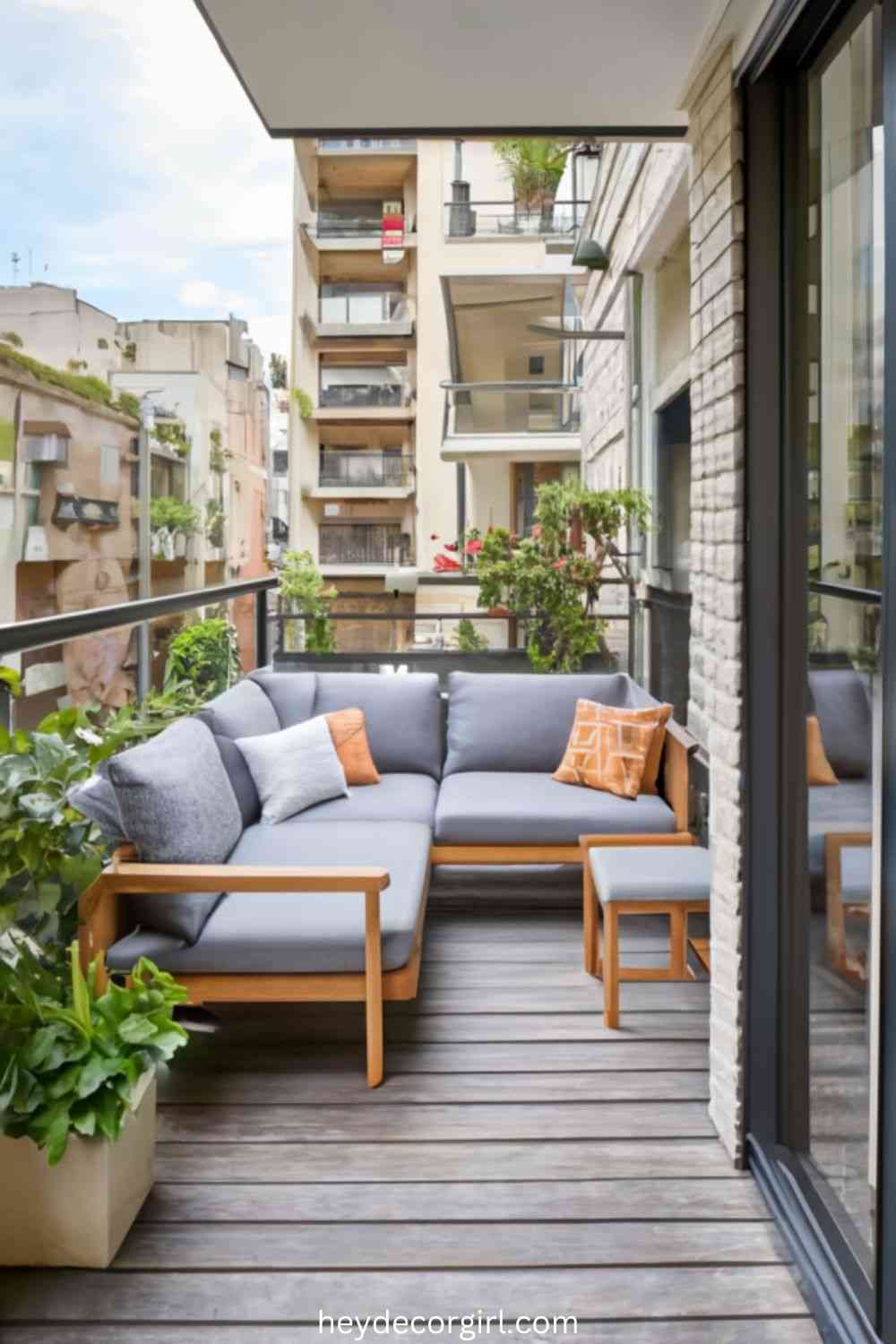
Setting up Furniture to Establish Natural Privacy Spaces:
Sectional Sofas and Lounge Sets:
- Description: Sit on sectional sofas or a lounge set and create separate seats on the balcony. Use them to create a U-shape or L-shape formation, which automatically separates the space and gives privacy.
Placement Tips:
- Put the sectional in front of a wall or privacy panel to accentuate the feeling of enclosure.
- Set up the sitting facing inward, with a small, intimate area, but with a lot of speaking and rest.
Screens and Dividers outdoors
- Description: This involves adding outdoor scenery screens or barriers to or behind the arrangements of furniture to delineate the various spaces. Such screens may be mobile or fixed, and they may be composed of bamboo, cloth, or metal.
Placement Tips:
- Install position screens in front of seating or dining areas to prevent sightseeing.
- Frame various functional areas like a reading corner or a dining area with dividers to make each area unique and intimate.
Planters and Greenery:
- A natural barrier between various furniture arrangements is formed by the use of tall planters or potted plants. Big, bushy plants might create a privacy screen and a natural element to the balcony.
Placement Tips:
- Position planters at the boundaries of seating or eating places to delineate and separate spaces.
- Plant tall and medium-height plants to achieve a layered and lush effect, which increases privacy.
Outdoor Rugs and Mats:
- Installation: Your outdoor rugs or mats can be used under various furniture groupings to help create a physical separation of space. Rugs may be used to delimit eating, resting, or other areas.
Placement Tips:
- Install rugs to fix pieces of furniture and make distinct areas on the balcony.
- Use heavy patterned or contrasting colored carpeting to highlight the distinction of various spaces.
Furniture of the various Zones:
- Seating Area: Lay comfortable outdoor sofas or chairs in a semi-enclosed space to provide a seating area. Include side tables and ottomans to make the place more efficient and comfortable.
- Dining Zone: Place a dining table and chairs somewhere very distinctly demarcated. Indicate the dining area with a mix of planters or screens, or even rugs.
- Relaxation Zone: This is a place where you can enjoy a hammock or a lounge chair with planters or screens to create a relaxing retreat. Make sure this space is comfortable to rest on and relax.
Multi-Purpose Furniture That Provides Some Privacy:
Outdoor Storage Benches:
- Description: Built-in storage benches provide seating as well as storage. They may also serve as bi-partitions between various sections of the balcony.
Privacy Benefits:
- Store benches are used as a barrier to seating or dining areas.
- Higher bench height can be a visual block and will also create extra seating and storage space.
Privacy Screens that have Built-In Shelves:
- Description: Plants or decor can be displayed with a notion of privacy through privacy screens with an integrated shelf or compartment.
Privacy Benefits:
- These screens should be placed between pieces of furniture in order to make separate spaces.
- Decorative objects or plants can be stored in the shelves, improving the aesthetic and practical value of the screen.
Partitioned Planters:
- Description: Areas may be separated by using planters that have built-in dividers or sections and include greenery on the balcony.
Privacy Benefits:
- Put up divided planters to give the balcony a line demarcation between various areas.
- The plants may be planted in and around seating or dining areas to provide a natural privacy aspect.
Controllable Outdoor Curtains:
- Description: Curtains that can be drawn or opened according to your needs. They may be suspended on tracks or rods and may be utilized to develop temporary privacy areas.
Privacy Benefits:
- Curtains should be used to shrink seating or dining space to a smaller size when not in use, and then opened to a broader space.
- The curtains may be drawn to offer more privacy or shade when needed.
Furniture Arrangement Ideas:
- Think Flow: Make furniture arrangements easy to move and access, but also to develop specific areas. Do not overcrowd the area and keep it comfortable.
- Use Layers: Layering together various elements like rugs, screens, and plants will bring about privacy and a more dynamic design.
- Balance: Furnish to create a sense of privacy and welcome by placing furniture such that there is a balance between aesthetics and utility.
Proper placement of furniture and use of multi-purpose furniture can help to improve the privacy and usability of your balcony to provide a comfortable and stylish outdoor oasis.
Also Read: 15 Best Small Balcony Decor
10. Pergolas and Canopies
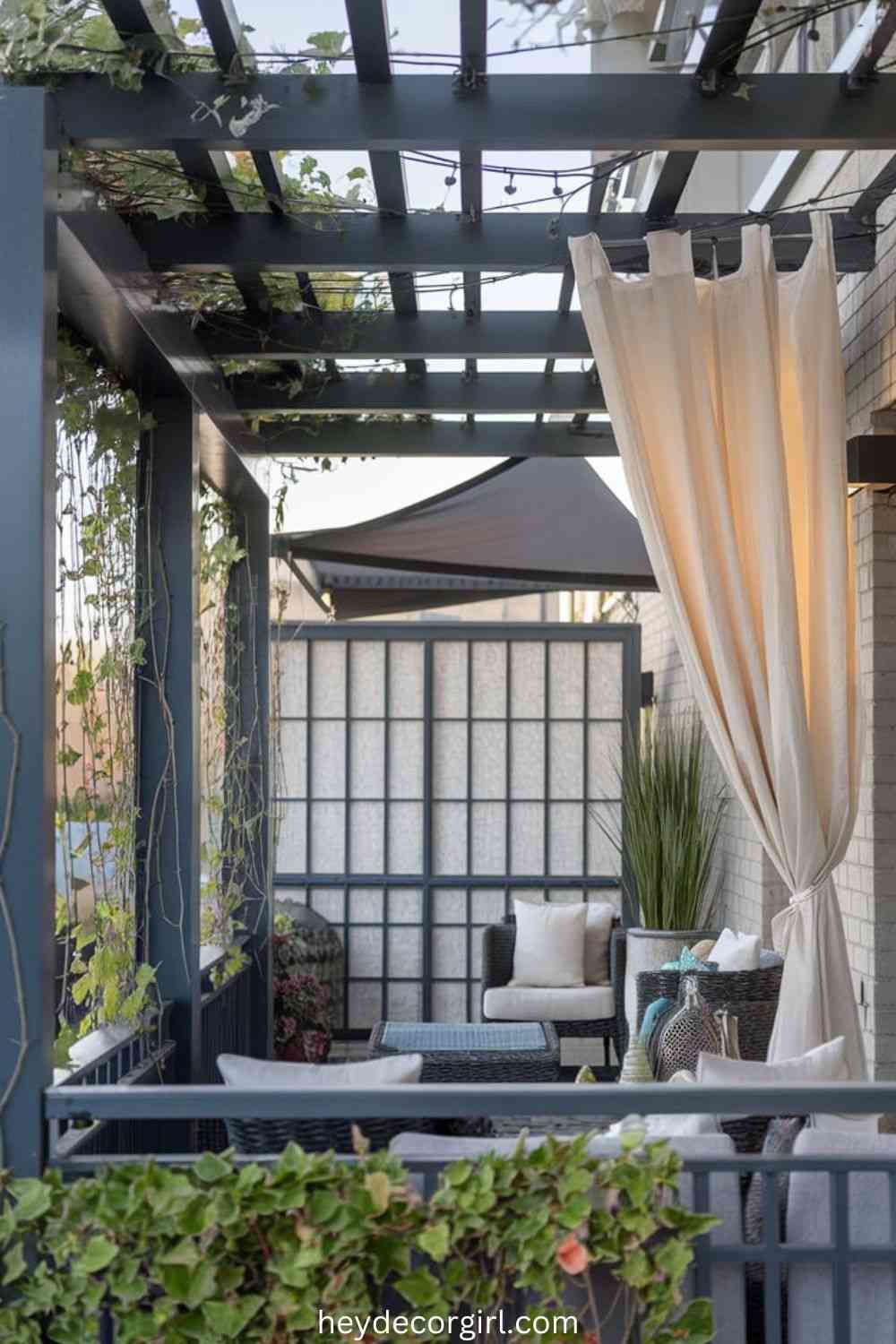
Using Pergolas and Canopies to make their space more private:
Pergolas:
- Definition: Pergolas are constructions that are characterized by the post and beam structure; these beams are horizontal and vertical, usually topped by a lattice or open roof. Privacy features can be added to them to make them a more secluded outdoor area.
Privacy Enhancement:
- Climbing Plants: It is important to add climbing plants or vines to the framework of the pergola to provide natural privacy and a green canopy. Examples are wisteria, ivy, or clematis.
- Curtains or Drapes: Hang outdoor curtains or drapes on the beams of the pergola to cover the area. They can be pulled and pushed to ensure privacy, and when necessary.
- Bamboo Screens: Screens made of bamboo or reeds can be attached to the sides of the pergola to create a rustic, natural appearance, which prevents outside views as well.
- Fabric Panels: Add some privacy and shade to the pergola by placing fabric panels on the sides or the top.
Canopies:
- Definition: Canopies are cloth coverings that offer cover and protection. They may be attached to a pergola or installed independently to improve privacy.
Privacy Enhancement:
- Side Panels: Design side panels of the canopy to form closed spaces and to exclude sights of neighboring spaces. These panels may be fabric or mesh.
- Retractable Options: Retractable canopies or shades can be used and extended when privacy is required and retracted when an open feel is desired.
- Close Canopies: Select canopies with sidewalls and have the entire canopy enclosed, providing complete protection and privacy.
Types of Fabrics and Designs that can be used:
Outdoor Fabrics:
- Description: Clothing meant to be worn outside is strong, weatherproof, and comes in various colors and patterns. They are suited to pergolas and canopies because they resist the sun, rain, and wind.
Fabric Options:
- Sunbrella Fabric: Is a durable and UV-resistant piece of fabric that is widely used in outdoor canopies and curtains.
- Canvas: Canvas is a heavy and tough fabric that offers good coverage and can be treated to prevent water problems.
- Polyester: Polyester is another cheap canopy and curtain fabric used outdoors, a nd it comes in a variety of colors and is lightweight.
- Mesh: Mesh fabrics are used as side panels or shades and allow air to pass through but offer privacy and protection against insects.
Designs:
- Solid Colors: Solid colored fabrics will give a smooth and modern appearance. Select the colors to match the decor of your balcony and to give the illusion of privacy.
- Patterns: Stripes, geometric designs, or floral patterns may provide visual interest and can be suited to the overall style of the balcony.
- Textured Fabrics: Texturedfabricss such as woven or embroidered textiles, provide a layer of depth, as well as privacy.
- Custom Designs: Custom-printed fabrics are available to give your garments a personal feel and a touch that reflects your style and tastes.
Installation Tips:
Pergolas:
- Mounting: Use the correct hardware to mount the curtains, screens, or fabric panels on the pergola structure.
- Accessibility: Select convenient ways to open and close curtains or retractable panels, including tracks or pulleys.
Canopies:
- Attachment: Attach side panels or retractable options to the frame of the canopy, with the help of clips or hooks.
- Durability: Choose high-quality, waterproof, or water-resistant materials and make sure it is installed properly so that it can stand up to the outdoor world.
Maintenance:
- Cleaning: Outdoor fabrics should be washed frequently, as per the instructions, to ensure their appearance and durability. Fabrics are mostly washed in mild soap and water. Storage: You should store fabric panels or canopies when not in use or during harsh weather, as they can be damaged.
With the help of the pergolas and canopies, you can provide more privacy in the balcony and make a comfortable and stylish outdoor space. Select suitable materials and design to fit your requirements and aesthetic orientation.
You May Also Like:
FAQ
1. How can we make an apartment balcony a little more private?
Answer: You can improve privacy by using such options as privacy screens or divans, outdoor curtains, vertical gardens, and planters. These elements can be added to provide natural barriers and allow your balcony to seem more isolated.
2. What are privacy screens and dividers? How do they work?
Answer: Privacy screens and dividers are available in different materials, including wood, bamboo, and metal. The reason is that they have been installed to prevent sight into the neighboring balconies or streets. They may be attached to walls, as freestanding units, or placed on existing structures, depending on the design.
3. What advantages does an outdoor curtain offer by way of privacy?
Answer: Outdoor curtains are versatile because the user can either draw them down to the last bit of privacy or roll them up to see the view. They are available in many materials, some being waterproof, and may be used to provide sun protection and wind and rain cover.
4. Are vertical gardens a way to gain privacy?
Answer: Yes, vertical gardens may serve as natural privacy screens. Create a green barrier to give both privacy and beauty by planting fast-growing plants or using pre-planted panels.
5. What kind of planters do you suggest to provide privacy to a balcony?
Answer: Tall and large planters or a dense planting are able to work best in privacy. You may wish to use planters that have climbing plants or cascading vegetation so as to provide a better barrier that is also aesthetically appealing.
6. What is the benefit of having a trellis with climbing plants on the balcony privacy?
Answer: Trellises are used to support climbers that may extend to cover the structure, forming a natural screen. This establishes vertical screening that makes the balcony more private and also introduces a greenish touch to the balcony.
7. What are the advantages and disadvantages of balcony enclosures?
Answer: Balcony enclosures like glass, acrylic, or mesh paneling provide total privacy and shield against the elements. Advantages consist of a contemporary appearance and less wind exposure. Cons can be high cost, possible reduced light, and difficulties in maintenance.
8. What can outdoor rugs and mats do to increase privacy?
Answer: Outdoor rugs and mats do not create privacy, but can be used to delineate and distinguish various spaces on the balcony. They make separate sitting or dining spaces to create an illusion of privacy in those areas.
9. What are privacy panes, ls, and how can they be configured?
Answer: Privacy panels can be defined as privacy barriers constructed of different materials such as wood, bamboo, metal, or fabric. They can be made in size, color, and design to suit your needs and aesthetic requirements. Panels are mounted on walls, placed as freestanding separators, or incorporated into other features of the balconies.
10. What are the benefits of pergolas and canopies?
Answer: Garden privacy can be achieved by means of pergolas and canopies with added structure that can be filled with climbing plants and fabric curtains or side panels. These extensions form a privacy zone and a protective zone.