![Hey Decor Girl [Latest Trending Decor Design Ideas]](https://heydecorgirl.com/wordpress/wp-content/uploads/2024/08/Heygirldecor-Logo.png)
Closet Ideas of Better Design are the keys to the best use of space and functionality of the large and small closets. No matter how small a wardrobe you have or how big your walk-in closet is, an appropriate design can make the storage process much simpler and help you better organize the items in your possession. A well-designed closet is able to maximize the space and enhance accessibility and the placement of everything. Whether it is smart shelf ideas or creative hanging arrangements, adopting smart closet concepts can really help make the most out of your closet and transform it into a clean and good-looking space.
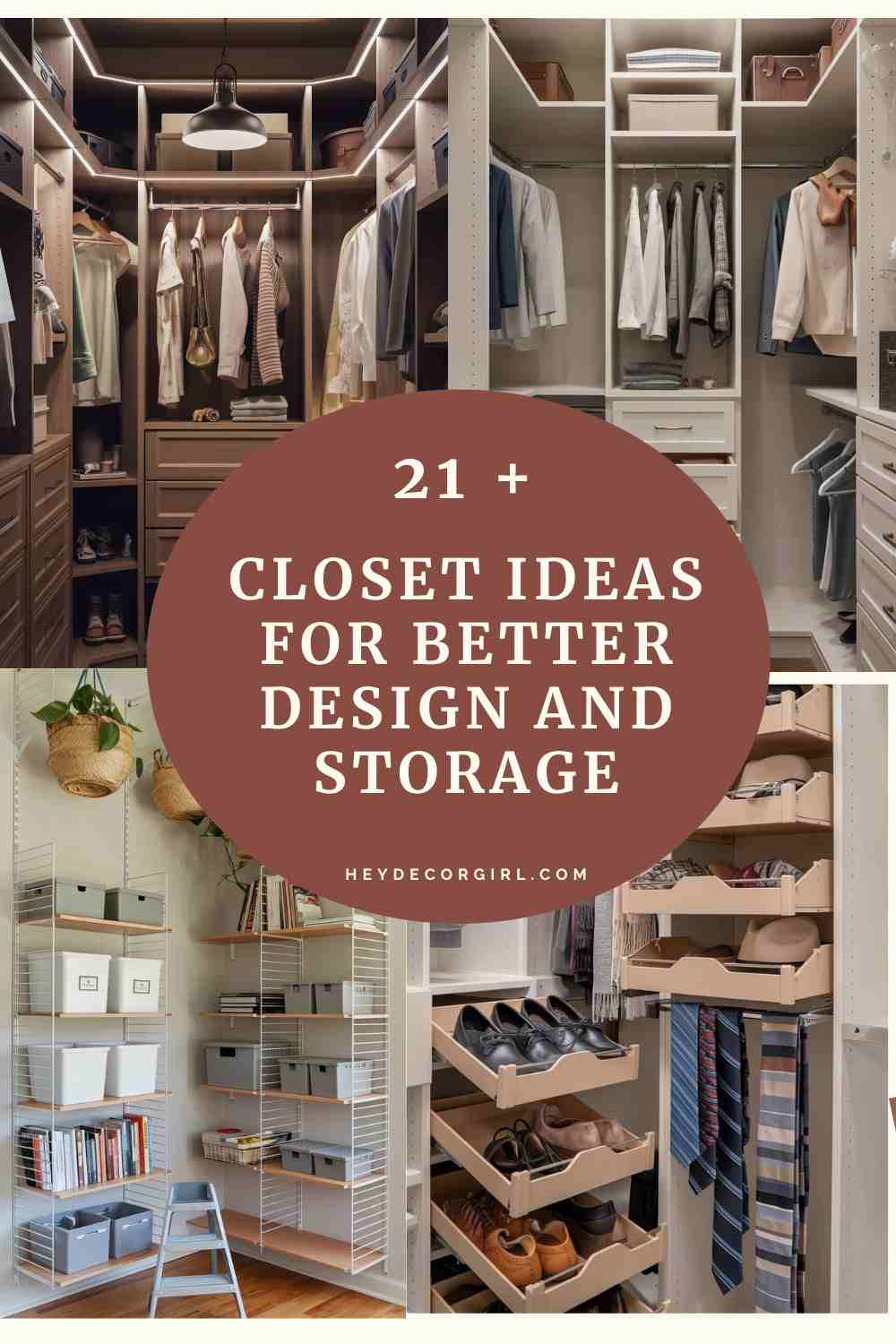
Amazing Closet Ideas For Better Design And Storage
1. Custom Shelving Systems
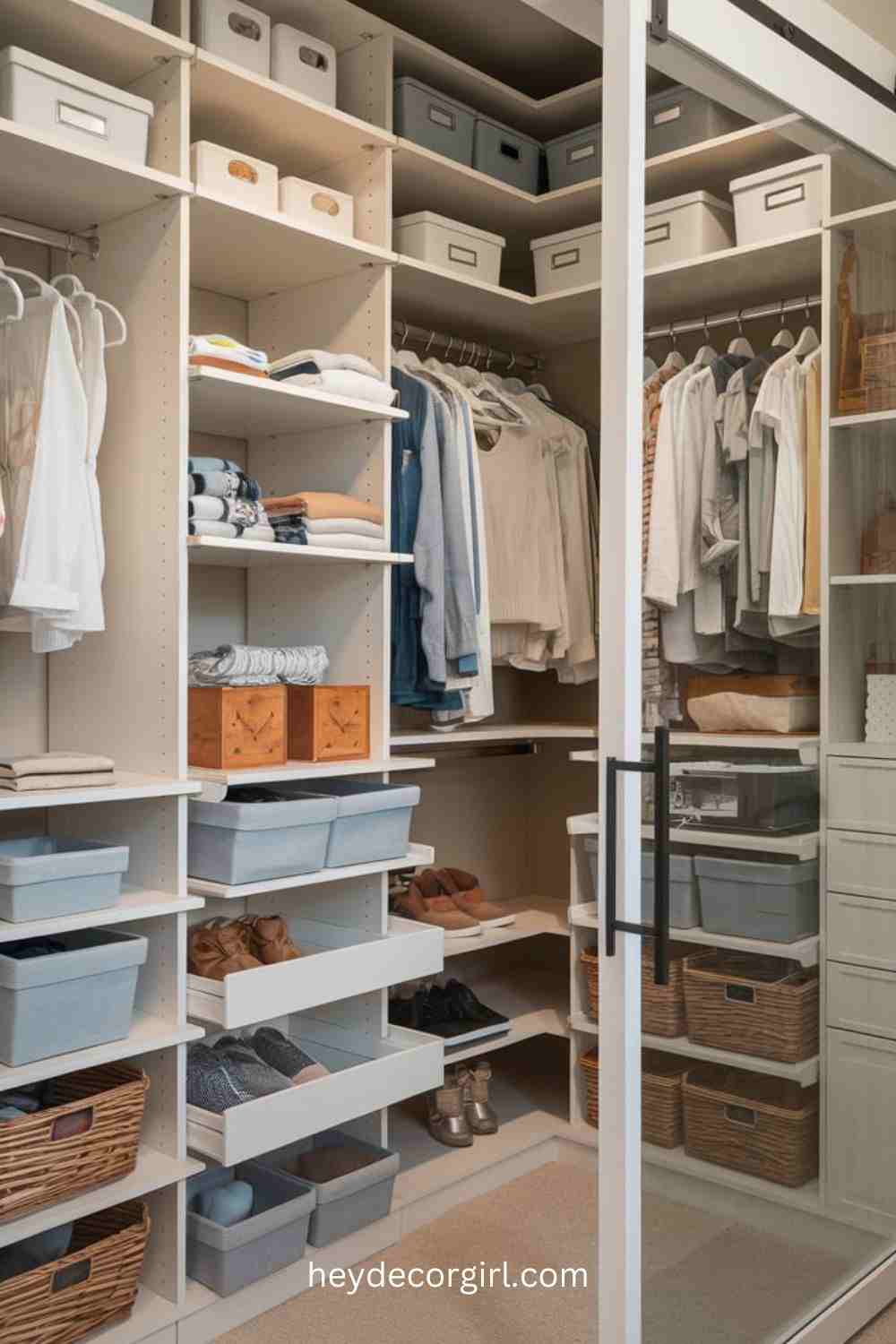
Individual shelving systems are a game-changer as far as the organization of the closet is concerned. They are flexible and customizable, and you can customize your storage to suit your needs. The following is an example of how custom shelving can make your closet look better:
Advantages of Adjustable Shelving:
- Flexibility: Adjustable shelves: The adjustable shelves will enable you to adjust the height and the structure of your shelves depending on what you would like to store. This flexibility ensures that it is easy to accommodate and adjust the storage requirements over time as you add new items or rearrange the existing items.
- Maximize Space: You can maximize the available space by moving the shelves up and down. It is more applicable in places such as closets where the items have different sizes; you will not have to lose out on high or low shelves.
- Better Organization: Flexible shelves can be used to make specific sections of specific types of products, such as shoes or folded clothing, and it is easier to keep everything tidy and accessible.
- Custom Fit: Custom shelving systems can be built to fit your closet precisely, giving you an efficient and smooth process of storage, and utilizing all the corners of the room.
Suggestions on how to incorporate Bins and Baskets:
- Clear Bins of Visibility: Clear bins should be used in order to store smaller objects, such as accessories, shoes, or seasonal clothes. You are able to see the contents of the bins on the spot without necessarily opening them, and this is excellent for quick access and organization.
- Stackable Baskets: Choose stackable baskets in order to develop a layered storage system. This method saves on the maximum use of the vertical space and enables you to sort and access things easily. Linens, shoes, or even toys will fit in stackable baskets.
- Labelled Containers: Add labels to bins and baskets to make sure that nothing becomes impossible to find.
- Labels bring order and ensure that everyone in the home finds and puts back goods to their respective place easily.
- Sleek and Utilitarian: Select bins and baskets that match your wardrobe. Baskets or fabric bins that are woven could be a nice touch, but remain practical and are both attractive and useful as storage pieces.
- Sliding Bins: Add sliding bins or drawers to your shelving system to make it even easier to access the items. They may come in especially handy as shoe or folded clothing storage, so that you can draw out a bin instead of having to reach into the back of a shelf.
Bins and baskets. Custom shelving systems combined with carefully selected bins and baskets can transform your closet into something more effective, orderly, and beautiful.
2. Built-In Drawers
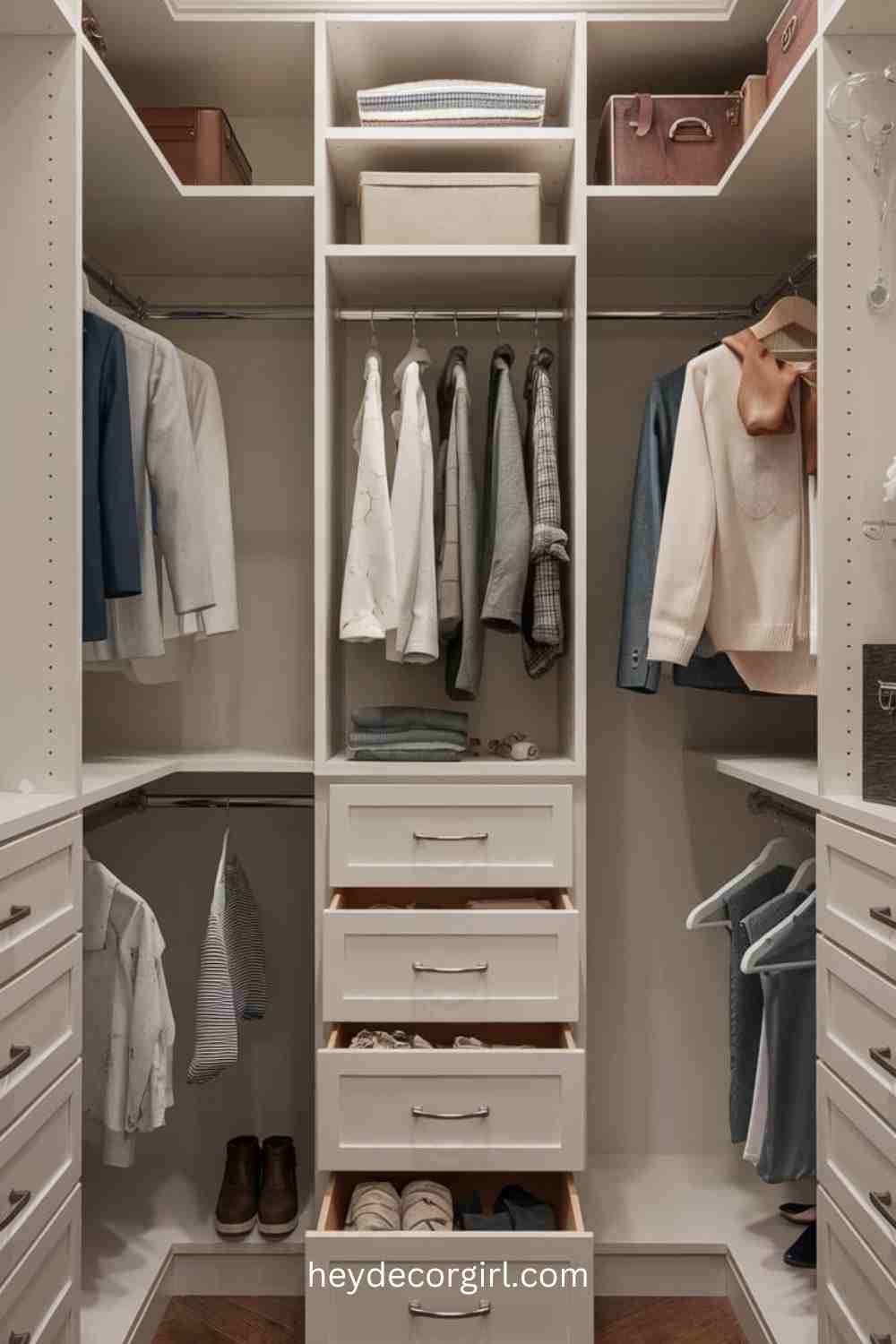
In-built drawers: This is a great solution for any closet, as they provide specific space to organize and also add more functionality to the entire space. Here is where built-in drawers may be used to change your closet design:
Making the most of Drawer Space in Smaller Closets:
- Narrow or Thin Drawer Units: Select small or slender drawer units when they fit in small areas. These units may be fitted at the side or in the center of a smaller closet to utilize space to the fullest without congesting the space.
- Vertical Storage: This is the use of vertical space where tall and thin drawers are installed. This method uses the entire height of the closet without occupying the floor space, which is suitable for small closets.
- Multi-Purpose Drawers: Select multi-purpose drawers with partitions or divisions within them, like those with inbuilt partitions. These may contain a range of objects, accessories, as well as folded clothes, without having to resort to additional storage options.
- Drawer Pull-Out Trays: Have pull-out trays or bins in the system of drawers to have easy access to smaller objects. These will come in especially handy in small closets where space is a precious commodity.
Advice on how to organize the various types of drawers
- Drawer Dividers: Divider is used to divide steps in each drawer. This would keep everything in order and avoid clutter, and hence easier to get and retrieve things in a short period.
- Accessory Drawers: Use separate drawers exclusively to keep accessories like jewelry, belts, and scarves. Set these drawers with smaller containers or trays to sort everything in them and have it visible.
- Folded Clothing Drawers: To store clothing, drawers with removable partitions can be used so that they can fit various categories of garments. As an example, folding clothes could be arranged into different compartments, such as sweaters, jeans, and t-shirts.
- Shallow Drawers of small items: Introduce shallow drawers of small items such as socks, undergarments, or ties. The shallowness ensures that it is easier to see and get these things without being required to shuffle through a deep drawer.
- Deep Drawers on Bulkier clothes: Deep drawers should be used on bigger clothes like jeans, jackets, or sweaters. Make these drawers easy to open and close, particularly when they are located in low sections of the closet.
- Labeling: Stick labels on the front of the drawers or in the dividers so as to be able to quickly find what is inside. This particularly comes in handy when it comes to maintaining order and putting things back in their respective place.
In-built drawers make the clothing unit more efficient because they provide a specific, accessible storage area for various types of things. You can achieve a more functional and efficient closet by maximizing the amount of space used in drawers and using good organization strategies.
3. Multi-Level Hanging Rods
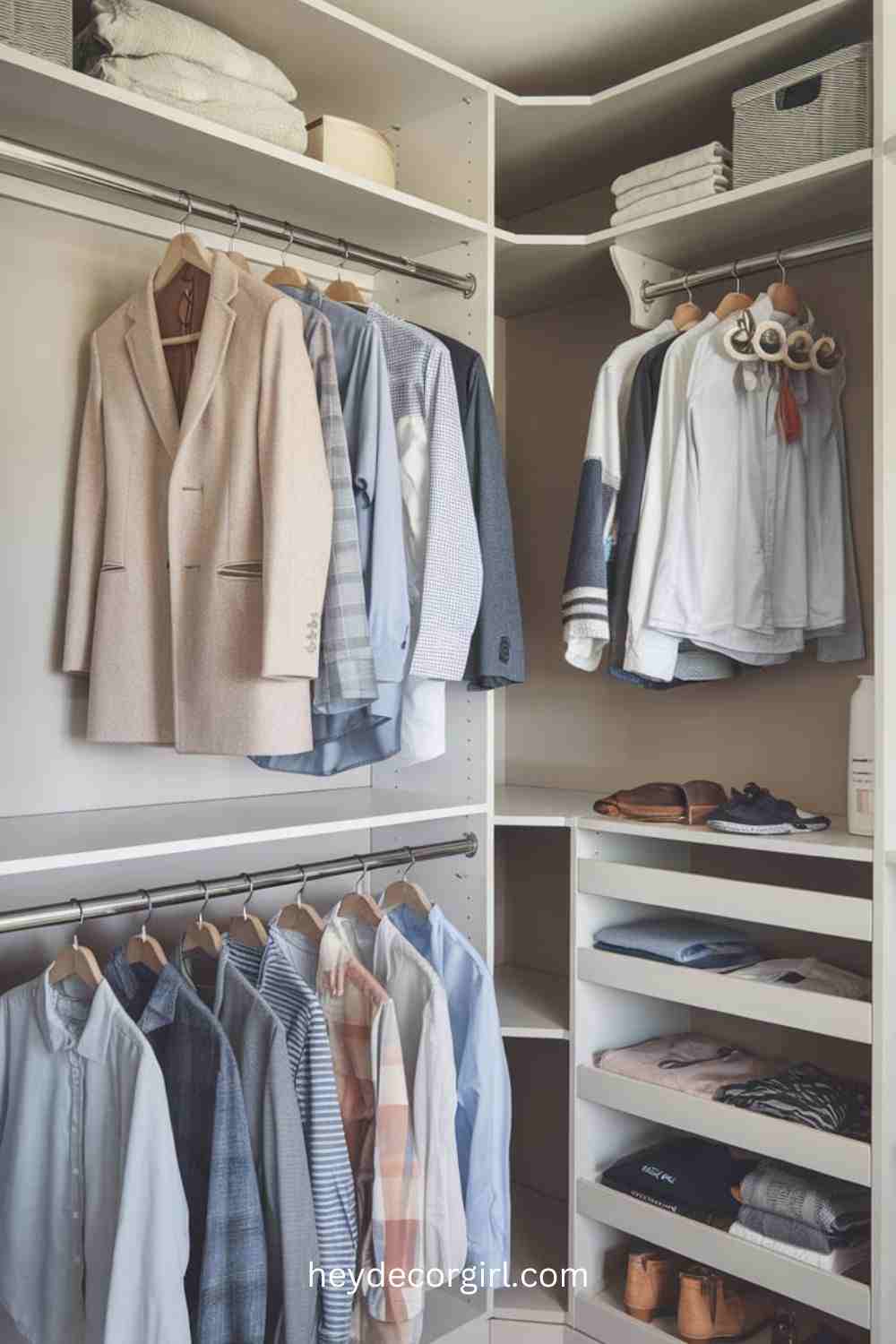
Hanging rods are a great alternative when there is limited space in the closets: multi-level hanging rods can be used to optimize the available space. You can also substantially add to the number of clothes you can hang by adding double or even triple rods, as well as ensuring your wardrobe is tidy and easy to access.
Making More Hanging Space by using Double or Triple Rods:
- Double Rod Systems: This one has a bottom rod below an upper one to form two layers of hanging space. This suits well where you have to store long and short items in a closet, and you want to gain the maximum space. As an illustration, long dresses or coats would use the upper rod, and shirts and pants would use the lower rod.
- Triple Rod Systems: Triple rods can be added to a closet that has deeper depth. This arrangement works well in sorting out the various categories of clothing or in the division of casual wear and work clothes. The arrangement of triple rods can be made with the upper rod being used to hold long items, the middle rod where shorter items can be placed, and the bottom one with accessories or folded clothes.
- Adjustable Rods: Use adjustable multi-level rods that can be adjusted to a higher or lower position. This gives it the flexibility to fit your new wardrobe needs or preferences, or your need to customize the hanging space.
Clothes Spacing and Organizing Best Practices:
- Adequate Spacing: Space between the rods should be adequate to prevent crowding of the clothes. Preferably, a minimum of 36-40 inches should be the distance between the top and bottom rods to be able to place long objects in one of the upper rods and shorter ones in the lower rod. In case of triple rods, the space between the rods must be at least 12-18 inches so as not to overlap.
- Sort by Type: This helps to organize the clothes based on their type or season using multi-level rods. As an example, put all your shirts and blouses on the lower rod and your jackets or dresses on the upper rod. This group is one that assists you in locating something within a short time and storing similar items.
- Hangle Wisely: The slim, non-slip hangers are used to maximise the space used by hanging and ensure that clothes do not fall off. The same thing is done by uniform hangers that create a more cohesive appearance.
- Add Dividers: Hanging dividers or additions on the rods, like hooks and shelves, can be added to give a greater degree of organization. Dividers may be made to maintain spaces between sections of clothing (e.,g. workclothes and casual wear).
- Accessibility: Locate commonly used objects in an easy-to-reach height. Store the items that you wear less often on higher rods or on the back of the closet to make sure that your favourite clothes are always available to you.
- Seasonal Rotation: These are some examples of how to rotate seasonal clothes between upper rods and lower ones. As an illustration, in winter, shorter winter jackets should be used with the lower rod, and summer clothes made in the upper rod. Replace them with new ones according to the changing seasons so that your wardrobe remains uncluttered and space-free.
Multi-level hanging rods are a flexible and efficient solution for a larger hanging space and for organizing your closet. With these best practices, you will be able to organize your closet most efficiently and maximize available space.
4. Over-the-Door Organizers
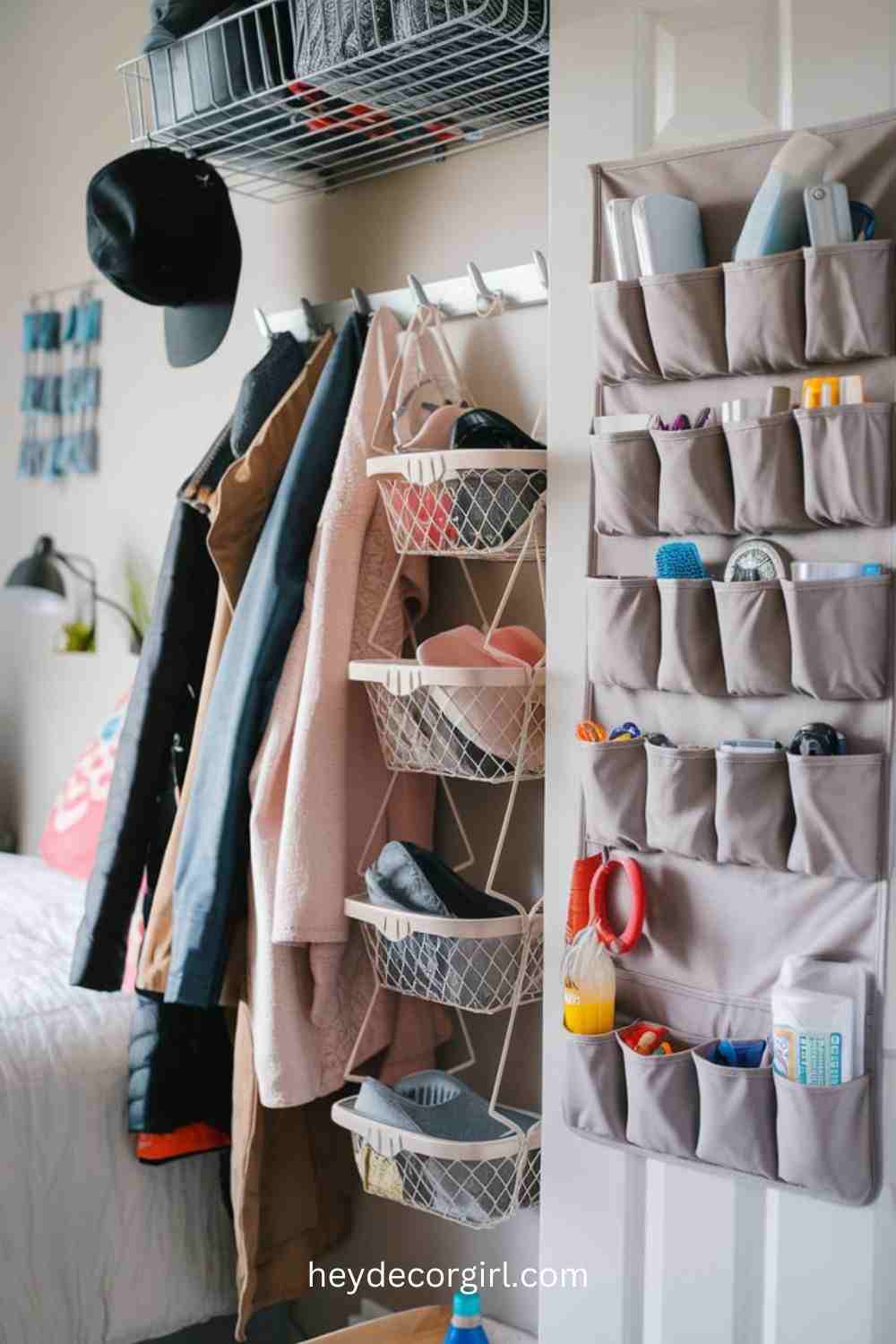
Organizers that can be used over the door are a convenient and compact way to store different objects and make them easily available to users. These organizers can convert the backside of any door into a storage space, and hence they are suitable for small closets or rooms where extra storage is necessary.
There are various over-the-door solutions:
- Pocket Organizers: These have several pockets made of fabric, plastic, or mesh and are suspended on a rack that is attached over the door. They are well for storing small items such as accessories, shoes, or cleaning items.
- Hook and Rack Organizers: Hooks and racks are designed to be attached to a door, which can be used to store equipment such as hats, bags, or cleaning utensils. Other models come with extra shelves or compartments.
- Shelf Organizers: Shelf-type organizers can be mounted on the rear side of a door and have a shelf (or several shelves). They are excellent for storing bigger objects like cleaning materials or footwear.
- Hanging Baskets: These are the organizers that consist of wire or fabric baskets that are suspended with hooks that fit into the door. They can be used to store a variety of products, including pantry products and cleaning products.
- Multi-purpose Organizers: There are also multi-purpose organizers, which have pockets, hooks, and shelves all in a single item to provide a wide range of storage options.
Them to use them on shoes, accessories, or cleaning supplies:
Shoes:
- Pocket Organizers: Pairs of shoes should be kept in the individual pockets. Make sure that the pockets are big enough to fit the size and the type of shoes (e.g., sneakers, sandals).
- Shelf Organizers: Shoes should be placed on the shelves and arranged according to type or frequency of use. This helps to keep shoes visible and accessible.
Accessories:
- Pocket Organizers: Jewelry, scarves, belts, and other accessories should be carried in small pockets. Clarity or mesh pockets are good to have so as to be seen and easily accessed.
- Hook and Rack Organizers: Hang some of the items, such as bags, hats, or necklaces, on hooks so they are not tangled and reachable.
Cleaning Supplies:
- Shelf Organizers: Cleaning supplies like sprays, cloths, and brushes should be kept on shelves. Make sure that the shelves are strong enough to support weightier objects.
- Hanging Baskets: Baskets are used to store cleaning items and materials. Baskets may be marked so as to be recognized easily.
Additional Tips:
- Space to the Max: Select organizers that have more or fewer parts so that they can fit various categories of objects and make the most of the available space.
- Labeling: Attach labels to pockets or baskets to be able to identify what was in them in a short period of time and stay organized.
- Accessibility: Organize items so that the most used items are placed at the front and infrequently used items are placed towards the back.
The over-the-door organizers represent a beneficial method of using the unused space that is frequently overlooked, which enables you to have your items well-organized and easily accessible without messing up your main storage space.
5. Vertical Storage Solutions
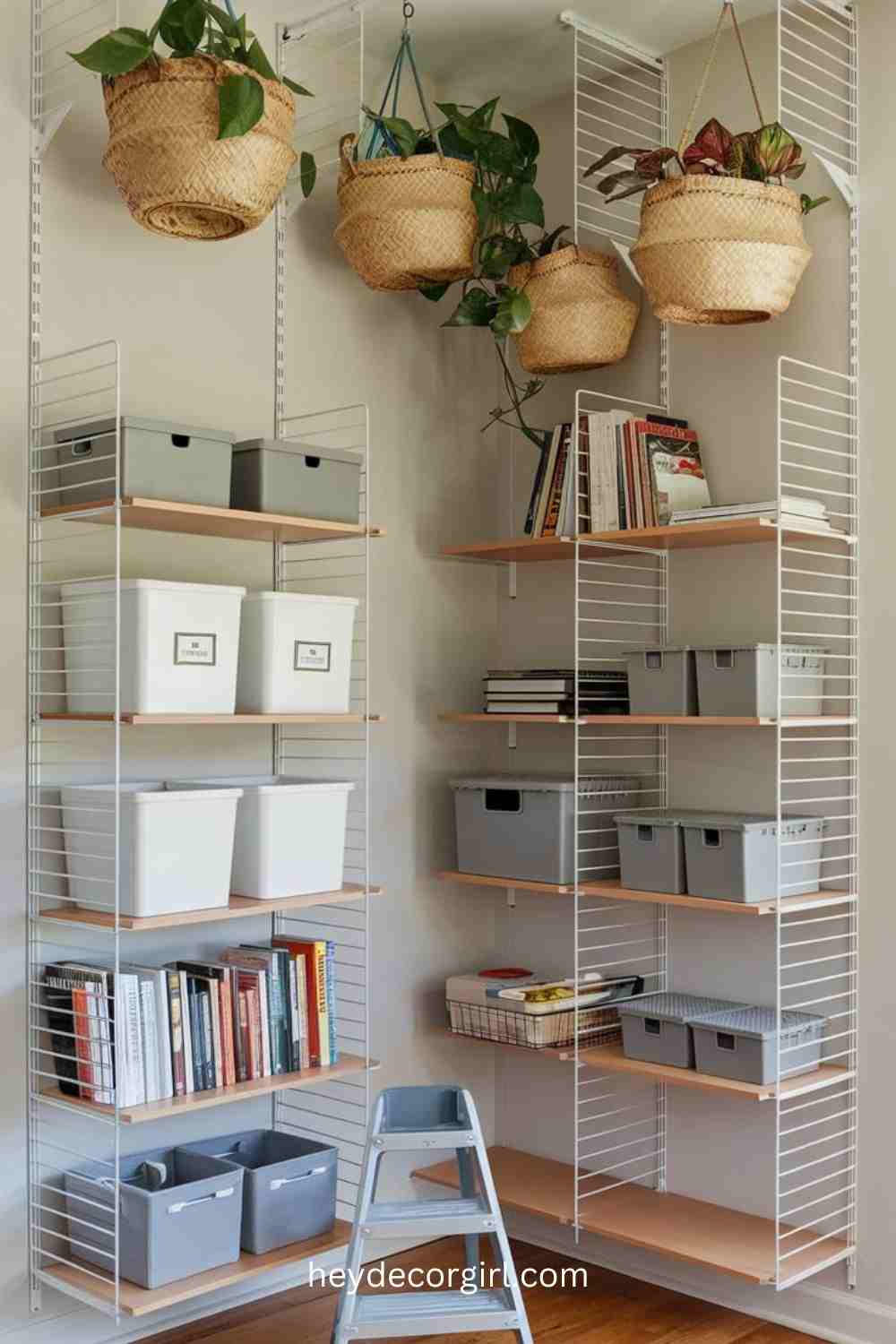
Vertical storage systems offer the best solution for maximizing space within the closet or a room that has limited space on the floor. With the help of the space height, you are able to generate a lot of storage space without using valuable floor space. The following are the ways to maximize vertical storage:
The use of Tall Shelves and Hanging Baskets:
Tall Shelves:
- Design and Placement: It is best to install tall shelves that extend to the ceiling to exploit vertical space. Remember to use adaptable shelves in order to fit objects that come in various sizes.
- Organization: Store infrequently used items or seasonal storage on the upper shelves. Everyday items can be kept in lower shelves so as to be easily accessed.
- Accessibility: Have a step ladder or stool to access higher shelves. Make sure that the shelves are firm and fixed.
Hanging Baskets:
- Types and Placement: Hanging baskets are used and can be hung on the bottom of the shelves or put on the wall brackets. They can be arranged on varying heights to create an effect of layers.
- Application: Hanging baskets should be used to store small or lighter items so that they can be visible and arranged in an orderly way. Perfect powdered goods such as pantry supplies, accessories, or craft supplies.
- Accessibility: Have baskets readily accessible or have higher baskets pull down more easily. Select baskets with open designs so that they can be seen.
Hints to reach High storage efficiency:
Step Stool or Ladder:
- Get a step ladder or a step stool so that you can reach high shelves safely. Use a foldable stool so that it can be easily stored when not in use.
- Make sure that the stool or ladder is tough and does not have a slippery surface.
Pull-Down Mechanisms:
- When it comes to installing shelves, it is possible to consider having pull-down racks or shelves that can be lowered when the need arises. It comes in handy, especially with high cabinets or shelves.
- Make the mechanism smooth and easy to work out.
Labeling:
- Label storage containers or baskets, particularly those that are on high shelves, so as to be in a position to identify the contents at ga glance without having to unpack them.
- Store containers or clear bins with items so that they can be seen without having to access them.
Organize by Frequency of Use:
- Put common things on shelves that are not tall but rather medium height and very accessible.
- Keep items that are not used frequently or seasonal on high shelves or hanging baskets.
Adjustable Shelving:
- Install shelving that can be rearranged as storage requirements change. This will have the advantage that it maximizes the vertical space.
- Depending on the size of the items that are stored, adjust the height of the shelves to save space.
6. Under-Shelf Baskets
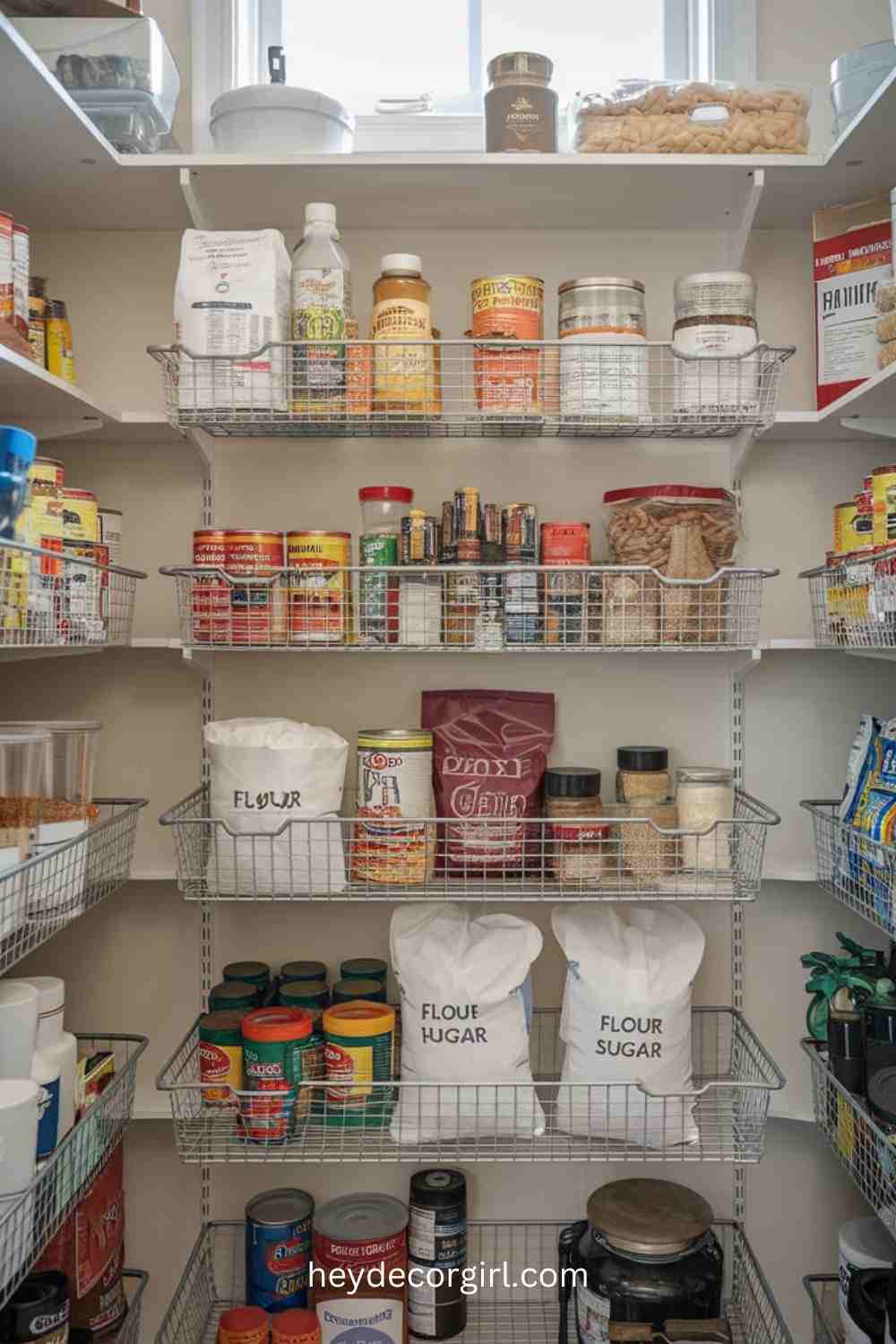
Under-shelf baskets are a convenient way of utilizing space in closets, cabinets, and pantries. These baskets will allow you to maximize every inch of space available beneath existing shelves by storing even more stuff and organizing it systematically, so that it is easily accessible.
Installing Additional Storage Under Available Shelves
Installation:
- Design: Display under-shelf baskets that can be readily slid onto the shelves or hang one on the shelves, either with hooks or clips. Showcase the various forms of collection, including a basket of wires or cloth bins.
- Placement: Show baskets put in different places, e.g., in kitchen cabinets, closet, or in pantry shelves. Make sure that the baskets are well attached and are in a position where they can be accessed.
Accessibility:
- Easy Access: Show how baskets may be easily accessed and taken off. Display baskets that slide or use hinges to conveniently access baskets.
- Clear Organization: Organize things so that they can be seen and reached without having to take the basket off altogether.
The perfect things to keep in the under-shelf baskets are:
Kitchen Items:
- Pantry Supplies: Keep non-perishable goods such as canned goods, dry pasta, and not-so-perishable snacks. Baskets are used in order to organize them and to avoid clutter.
- Utensils and Tools: Use baskets to store the kitchen utensils, measuring cups, or small appliances that may not fit in the normal drawers.
Closet Items:
Accessories: Prepare accessories like scarves, belts, or hats. Baskets are used to store these things so that they are organized and easy to locate.
Shoes: Store shoes or other small objects, such as shoemaking supplies. Baskets may be used to make the most of a closet or an entrance.
Craft Supplies:
- Art Supplies: Store craft supplies such as markers, glue, or fabric in baskets. Hampers store products can be accessed easily whenever required in quick projects.
- Small Tool: Pay for Small tools or materials used to craft or DIY projects.
Cleaning Supplies:
- Household Cleaners: Store cleaning products in place. Sprays, cloths, and Brushes can be kept in baskets, and one finds what they require easily.
Additional Tips:
Labeling:
- Label baskets to confirm the contents of the baskets in a short time, particularly when the baskets are used for a variety of products.
Size and Fit:
- Make sure that the size of the under-shelf baskets is not too large to fit into the size of your existing shelves. Select baskets that are not very deep or wide so that access and visibility are easily achieved.
Mix and Match:
- Combine two types of baskets (e.g. w, wire and fabric) based on what you are storing and the beauty of your room
Avoid Overloading:
- Baskets should not be overloaded; this will render the basket a hard-to-reach place and may even destroy the shelf or basket.
Additional Elements:
- Good Lighting: The area should be well-lit to emphasize the presence of the organization and the availability of the under-shelf baskets.
- Clean and Tidy Arrangement: Arrange a clean and tidy appearance to demonstrate how under-shelf baskets can be used to control clutter and to maximize space.
7. Pull-Out Racks and Caddies
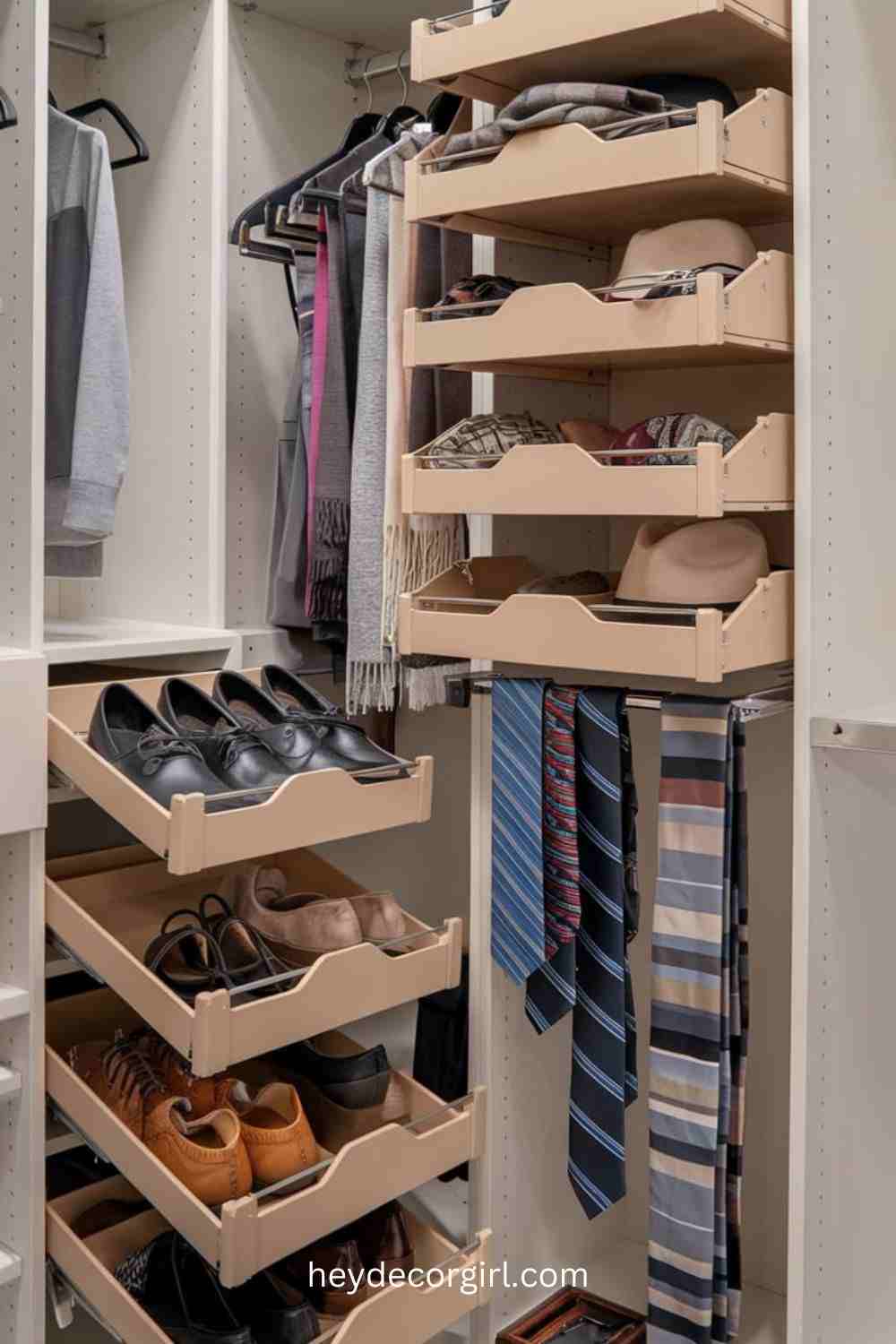
Pull-out racks and caddies are a new form of storage that will be useful in making the access and organization of the closets, kitchen, and other areas more viable. These enable you to access very easily what is in cabinets or higher shelves without attempting to stretch to reach them or rummage through a mess.
Adding Pull-Out Features to gain Easy Access:
Design and Installation:
- Pull-Out Racks: Show racks that are rolled out of cabinets or shelves, the racks are used to store different things. Add pictures of racks with more than one layer or level.
- Pull-Out Caddies: These caddies have a pull-out feature and allow the use of compartments or baskets to arrange items. Make dividers in the highlight caddies.
Accessibility:
- Cookability: Show the pull-out features that enable you to access the items stored in hard-to-reach locations easily. Show racks and caddies are pulled out to show how they work.
- Smooth Operation: Show the smooth sliding motion of the racks and caddies, and the ease of use of the racks.
Shoes, Ties, and Accessories:Examples:
Shoes:
- Pull-Out Shoe Racks: Show a pull-out rack expressly designed to hold shoes. Display varying heights of racks and shoes should be well organised to optimize space.
- Storage Capacity: Provide examples of racks that can hold different types of shoes, e.g,. sneakers, hee,ls or boots.
Ties:
- Tie Racks: Have a pull-out tie rack that contains several hooks or somewhere that the ties can be stored. Tie collections grouped according to color or pattern.
- Organizational Features: This means having racks that have features that ensure ties do not become entangled or wrinkled.
Accessories:
Accessory Caddies: Show pull-out caddies with pockets where you can store accessories like jewelry, belts, or scarves. Demonstrate the way various accessories can be properly kept and easily retrieved.
Adjustable Compartments: Have examples of caddies whose partitions can be adjusted according to the sizes and types of accessories.
8. Rotating Shoe Racks
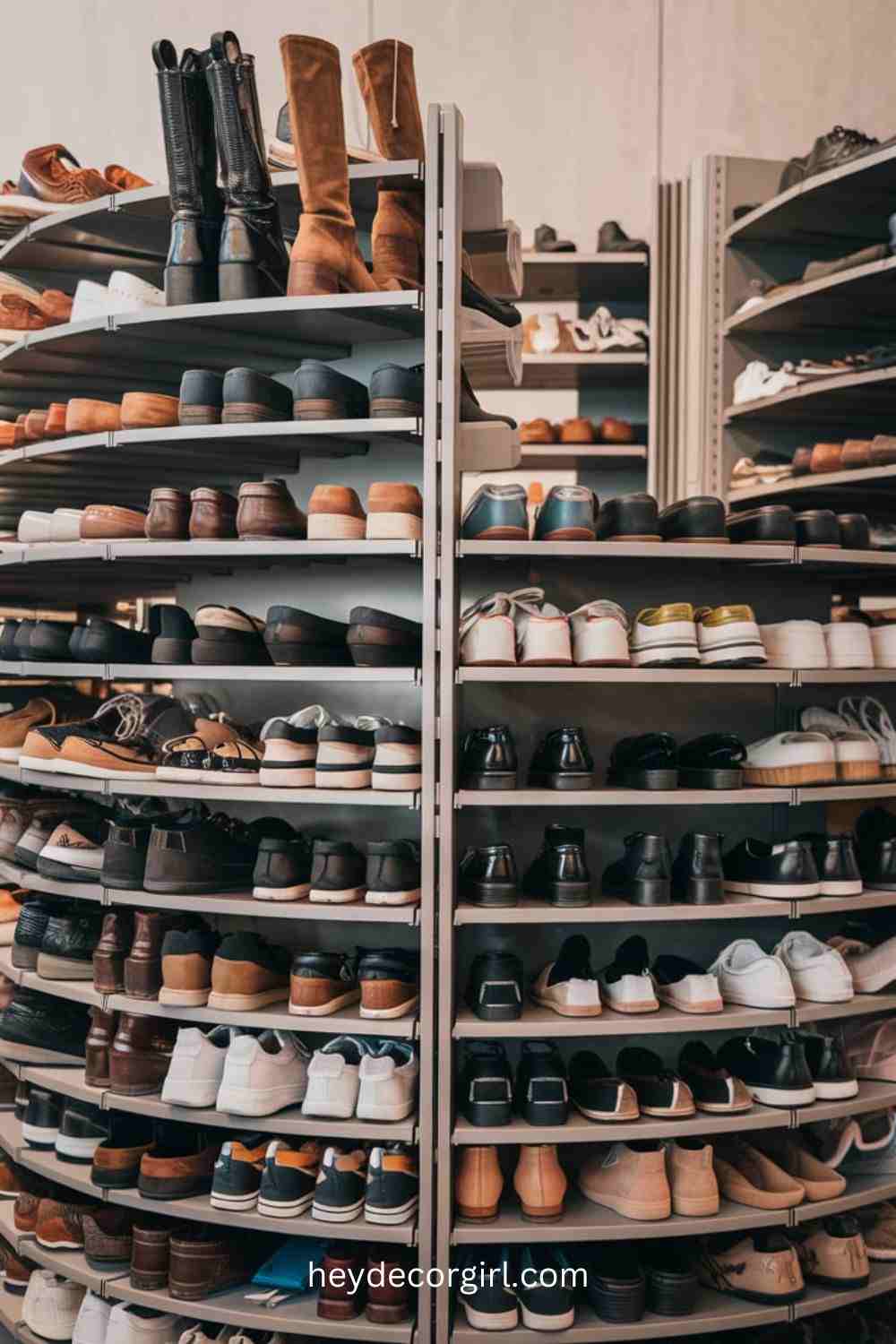
Rotating shoe racks are a new type of shoe storage designed to maximize the use of shoe storage and make it more accessible. These racks are designed to occupy small and large spaces well, as they employ a rotating system to serve as a more effective means of storage and retrieval of shoes as part of creative closet ideas to enhance better design.
There are advantages of Rotating Racks to Shoe Storage:
Space-Saving:
- Minimalist Design: Demonstrate the ability to rotate shoe racks to fit a great number of shoes into a small space. Point out the design, which uses the vertical space to its maximum, or fits into the corner areas.
- Effective Organization of Space: Demonstrate how the rotating aspect can fit in tight or awkward areas where traditional racks may not be possible.
Accessibility:
- Simple to use: Show the rotating machine in use, demonstrating how the users can view all the shoes without necessarily digging or pulling out other shoes.
- Rotation: Focus on the fact that the rotation feature will enable the presence of all shoes in a convenient view, which will help users with the quick finding and selection of the desirable pair of shoes.
Other Features to be noted:
Adjustable Shelves:
- Customization: Have pictures of rotating racks with adjustable or adjustable shelves where the shoe size and type can be customized.
- Flexibility: Demonstrate how the rack may adapt to a variety of footwear, including high heels and boots, by changing the shelf heights.
Material and Design:
- Construction: Not only emphasize the materials of the rack (heavy metal or wood), but it also makes sure that the materials are durable and stable.
- Aesthetic Only: Showcase various design styles, including sleek modern design, more traditional or rustic design, to demonstrate that the racks are compatible with many different decor styles.
Installation:
- Easy Installation: Demonstrate how rotating shoe racks can be installed with ease in various areas, including closets, entryways, or dressing rooms.
- Space Efficiency: Demonstrate the ability of the rack to fit into different space areas, such as a tight corner or a small closet.
Additional Elements:
LightingMakingKeepingp the lights on is a good way to demonstrate the rotating property and the advantages of the rack in terms of accessibility. The use of bright lighting makes it easier to put emphasis on how easily the rack can be used and the way it stores shoes.
Organizational Benefits:
- Visual Organization: Display an attractive display of shoes on the rack, which enables the shoes to be in order and accessible.
- Less Clutter: Show how the rotating rack will lessen the clutter by giving each pair of shoes a specific area.
Aesthetic:
- Contemporary and Clean: Choose the contemporary design that fits different interior designs. Make sure that the rotating rack appears to be stylish and functional.
- Visual Appeal: It includes pointing out the rotating mechanism and the design as a whole to reinforce both the practical and the aesthetic advantages.
9. Labeling Systems
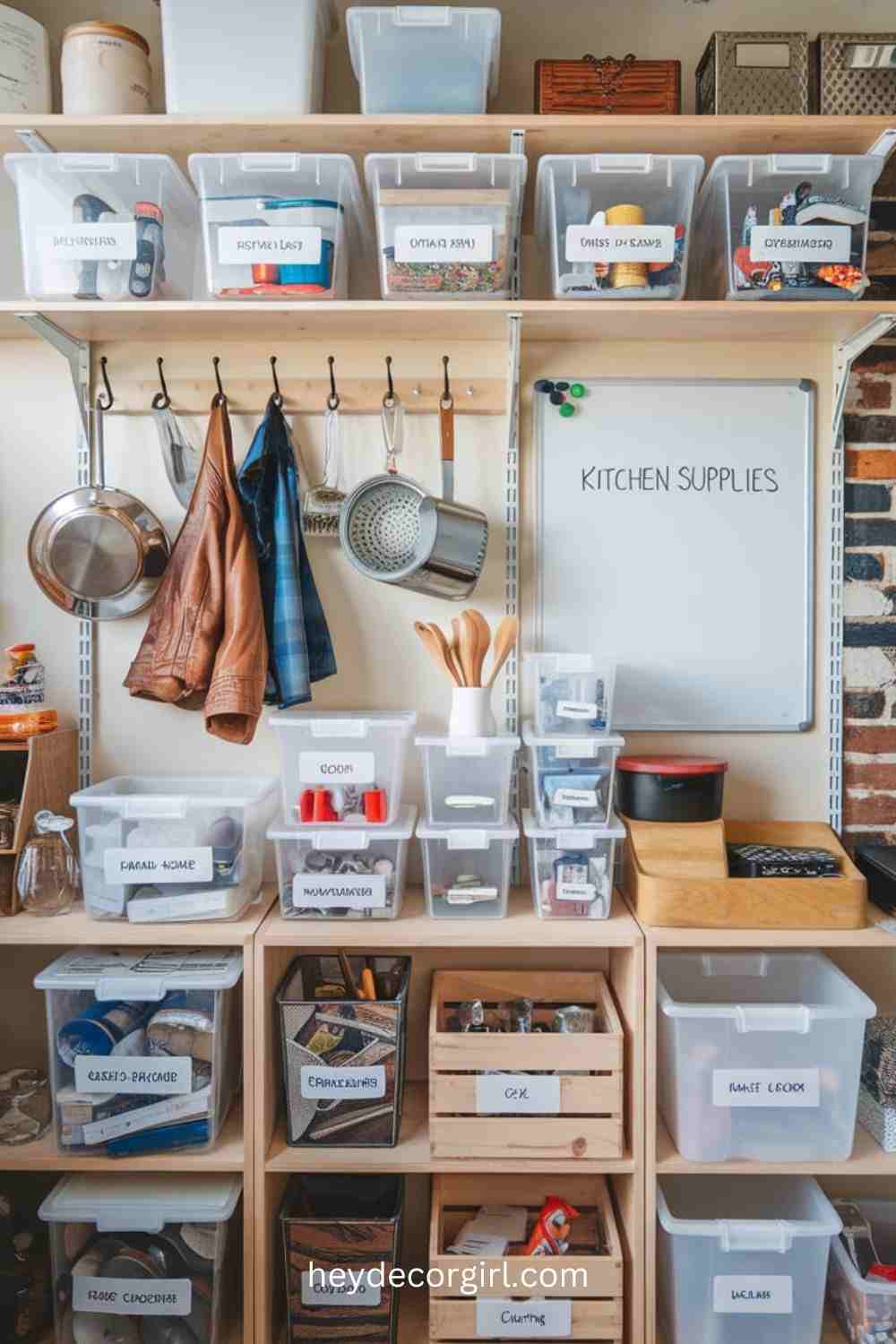
Label systems are required to keep orderliness and effectiveness in different storage facilities. Regardless of the DIY approach you take or the solutions that are sold in the stores, by labeling items appropriately, you get to easily locate and identify things, simplifying your daily life routines and making the spaces free of clutter. These design improvements can be done by using these ideas of closets to ensure that your storage units are more functional and that your closet is a useful and beautiful place to be.
The Significance of Labeling to Organization:
Enhanced Organization:
- Visual Clarity: Demonstrate how labeling can give you an easy and direct recognition of objects and will save you the hassle of rummaging through piles and shelves to locate what you want.
- Categorization: Demonstrate how labels can be used to group or classify objects into a collection or category, e.g., kitchen supplies, office supplies, seasonal clothing, etc.
Time-Saving:
- Quick Access: Show how the labeled storage solutions save time when searching for items, as all of them are labeled and they are easy to find.
- Efficiency: Emphasize the way an efficient system with organized and labeled items can lead to efficiency in personal and professional life, where you can access items you use frequently.
Home-Made and Commercial Labeling Ideas:
DIY Labeling Ideas:
- Custom Labels: Display examples of homemade labels made with materials like chalkboard labels, printable label sheets, or homemade labels. A range of styles and designs should be used, such as an option of hand-written labels or a label maker.
- Creative Solutions: Add creative labeling concepts, i.e., washi tape, craft paper, er, or decorative labels, depending on what the space looks like.
- Reusable Labels: Includes labeling solutions that can be reused, e.g., dry-erasable labels, clear plastic sleeves with insert card, etc., so that label updates and changes can be easily done.
Store-Bought Labeling Ideas:
- Pre-Made Labels: Show store-bought labeling options, including adhesive labels, label makers, or pre-printed tags. Present various sizes and styles to suit the needs of various storage.
- Labeling Kits: Provide pictures of finished labeling kits, which include various types and sizes of labels, and are designed to address various organizational projects.
- Decorative Labels: Highlight decorative labels available in different designs and colors, thus increasing functionality and beauty. Display labels that may be placed in various locations, including in the kitchen, offices, or closets.
Additional Elements:
Label Placement:
- Visibility: Demonstrate labels that are located in invisible locations where they are readily read and accessed. Mark labels on various kinds of containers, shelves, or drawers.
- Uniformity: It is advisable to have uniform labeling across similar items or categories to ensure uniformity and ease of use.
Labeling Techniques:
- Typography and Fonts: Showcase the various font types and font sizes used in labeling to help it be read. Do illustrate bold and clear text to emphasize relevant information.
- Label Durability: Incorporate examples of labels that are durable enough to resist frequent use or other outdoor environmental factors, like waterproof or tear-resistant labels.
Aesthetic:
- Sympathetic Design: Make sure that the labeling system is consistent with the overall design and decor of the space, i.e., minimalist, modern, or traditional style.
- Visual Appeal: Select labels that augment the appearance of the storage site as well as offer useful advantages. Show the benefits of labels being functional as well as stylish.
Lighting:
Provide bright settings to clearly indicate the labels and their location. Make sure that the labels are readable easily as well, and the positioning should be well illustrated.
10. Lighting Solutions
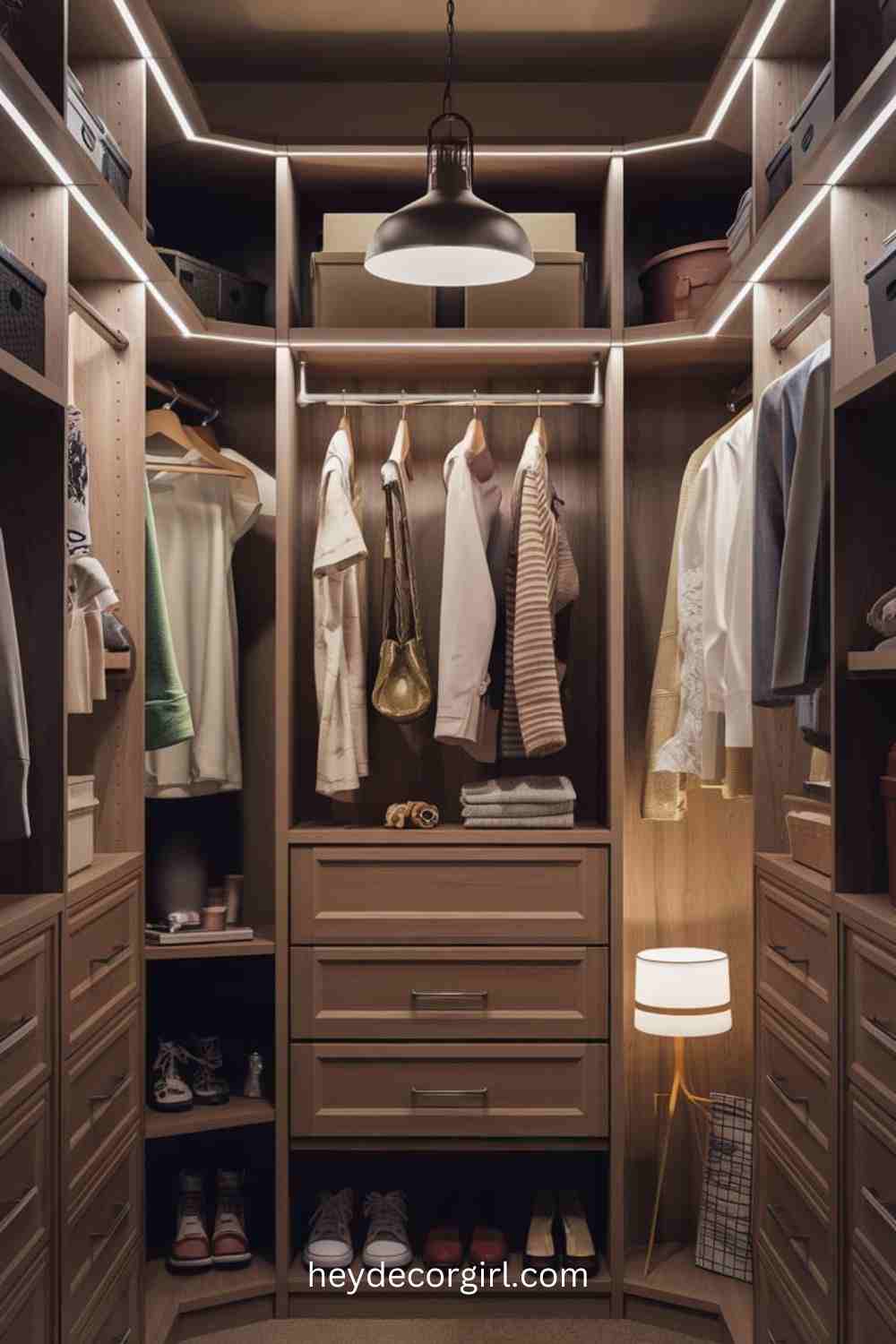
Good lighting is essential in increasing the visibility and functionality in the closets, and that makes them no longer dark and messy but well-lit and easy to navigate. Not only does proper lighting ensure that you can find and get what you want easily, but it also enhances a certain level of elegance and sophistication to your storage areas. The concept of thoughtful closets helps achieve a good design by making sure lighting suits the whole design,gn optimizing both the look and the use.
Increasing Visibility through Closet Lighting.
Increased Functionality:
- Better visibility: Adequate lighting allows you to see all areas of your wardrobe, which means that you can find clothing, accessories, and other items more easily. This saves time wasted in trying to find something in the dark areas, and frustration is avoided.
- Improved Organization: When the lighting is good, the shelves and compartments are well arranged, thus keeping the place tidy. It enables more effective visualization of objects, which promotes more effective organization and use.
Aesthetic Appeal:
- Visual Appeal: Good lighting can also improve the visual appeal of your closet, as it gives it a better look and makes it look friendly and well-designed. Emplolighting to spotlight certain parts, such as a well-organized shoe rack or a fancy jewelry shelf.
- Lighting: Select lighting to match the general aesthetic of your closet, either to add some elegance or comfort to the room. This can enhance the general experience of using your closet; it could seem more like a luxury in your house.
Types of Lighting Options
LED Strips:
- Flexibility: Display LED strip lights that are mounted on shelves, under hanging rods, or in cabinetry. These lights bring about even lighting and can be installed in any arrangement to match the arrangement of the closets.
- Energy Efficiency: Emphasize the economical traits of the LED strips, which are less costly to use than the conventional alternatives, and they offer clear, bright light.
- Customization: Demo that the LED strips can be customized with color temperature controls (warm or cool light) and dimmable options, to fit the required ambiance.
Motion Sensors:
- Convenience: Show some motion sensor lights, which turn on once you enter the closet and turn off once you leave. This is a convenient and efficient feature, particularly in the commonly used closets, which are hand-free.
- Installation: Display: Have samples of motion sensors installed or mounted in some places, like by the entrance to the closet or inside the drawer, to show the versatility and efficiency of the motion sensors.
Recessed Lighting:
- Sleek Design: The lights feature recessed lights that are put in the ceiling or over the shelves, giving the building a clean and streamlined appearance. This kind of lighting is best suited to create a modern, rn nonsensational design.
- Focused Illumination: Learn how recessed lights can be installed to give focused illumination to a particular space, like a dressing space or accessory display.
Puck Lights:
- Spotlighting: Showcase puck lights are employed to highlight a certain part or piece of the closet, e.g,. A jewelry rack or a designated shelf. They are small lights and can be either mounted or adhesive, giving them flexibility in their use.
- Aesthetic Enhancement: Demo how puck lights can bring a cool aspect to the closet and also give it functional lighting, which improves the appearance and usability of the closet.
Under-Shelf Lights:
- Lighting Shelves: Under-shelf lights. Under-shelf lighting can be used beneath shelves to light the products beneath. This kind of lighting is particularly helpful in illuminating smaller objects or making dark places bright.
- Subtle Lighting: Demonstrate examples of subtle low-profile lights that do not overpower the room but give it a gentle glow, making the look balanced to subdued.
Additional Elements:
Lighting Controls:
- Dimmers and Timers: Add photos of dimmer switches or timers that can be adjusted to various levels of lighting and automatically shut off, which adds the convenience of customization to the lighting system.
Installation Tips:
- Professional or DIY: Advise on whether the lighting should be installed by a professional or by the Do-It-Yourself, based on the intensity of the installation and on what effect is required.
Aesthetic:
- Design Integration: Be sure that the lighting choices match the overall design and style of the closet, be it contemporary, classic, or minimalist.
- Visual Appeal: Select lighting elements that add aesthetic value to the closet in addition to its functional utility to ensure that the space is beautiful and useful at the same time.
Lighting:
- Bright and Clear: Bright and clear lighting should be used to present the various lighting options and how they affect the visibility of the closets clearly. Make sure that the lighting can help to improve the space in terms of appearance and functionality.
FAQ
1. What are a few helpful guidelines in designing a workable closet?
Answer: Begin by determining what you need to store and how you use your closet. The Ideas on Closet Ideas For Better Design would be to use vertical space with adjustable shelving, to have hanging rods at different heights, and to think of multi-functional storage devices such as drawers and bins. Functionality is also important in terms of good lighting and access.
2. What can I do to utilize the most space in a small closet?
Answer: To get the most out of a small closet, add slimline hangers to create more hanging area, add adjustable shelves to suit various items, and add over-the-door storage organizers to get additional space. Closet Ideas For Better Design also recommends the use of the back of the closet door, as well as the use of a second hanging rod to accommodate shorter objects.
3. What are the storage options of a walk-in closet?
Answer: Add built-in shelves, drawers, and hangers in a walk-in closet so that you can store things in an organized manner. Close Ideas To Improve Design will be the use of a center island with storage of accessories, such as a bench where people can sit, and the use of clear bins or baskets to ensure that the items are seen and easily accessible.
4. What can I do to plan a closet based on the change of seasons?
Solution: Keep out-of-season clothes in seasonal bins or vacuum-sealed bags. Simply include these Closet Ideas For Better Design by changing the shelves and drawers of your wardrobe so that what is in season is at eye level and off-season clothes are placed in the upper shelves or drawers. Label bins to make it easy to identify them.
5. What are some design concepts of a shared closet?
Answer: To share a closet, combine a mix of two hanging racks to fit various heights of clothes, space them out, or divide them into individual areas; meanwhile, share storage methods such as drawers and shelves. To ensure that things are organized, clear labeling and color-coded storage can be used. The Closet Ideas of Better Design can make a great contribution to optimizing the functionality and order.
6. What can I do to a closet to make it look better?
Answer: Advertise the walls with decorations such as wallpaper or paint, buy stylish storage bins or baskets, and LED lighting or pendant lights to make it look modern. Select matching hangers and drawer pulls to make the look more attractive. These constitute all the good Closet Ideas For Better Design.
7. What are the cost-effective concepts of organizing the closet?
Answer: Do-it-yourself shelving with the help of materials found in hardware stores, using used components, such as mason jars, as accessories, and inexpensive storage bins or baskets can serve as an answer. You can make yourself concentrate on maximizing existing resources and making minor changes to make the best use of what you have by including Closet Ideas For Better Design.
8. What can I do to make closets more accessible to people with disabilities?
Answer: Add adjustable shelves and drawers that can be pulled out so that it is easier to reach, hang lower on the rods, and design a closet so that it can be accessed using a wheelchair. Include Closet Ideas For Better Design so that everything is easy to see and get to place, and make use of aid appliances such as extended grabbers as required.
9. What are custom closet systems? What are the advantages of using them?
Answer: Custom closet systems provide customized storage systems that are designed to meet your needs and area. They optimize storage space, increase organization, and can be made to match the decoration of your home. To design it better, it is better to consider numerous different ideas of closets that can be modified over time.
10. What can I do to have a well-organized closet in the long run?
Answer: Clean out your wardrobe regularly and re-evaluate your wardrobe to match your fresh requirements. Introduce a seasonal rotation system, conduct regular audits to eliminate unused products, and ensure consistency in regular maintenance to ensure that things are in order. Closet Ideas For Better Design may assist in using as much space as possible and enhancing functionality.